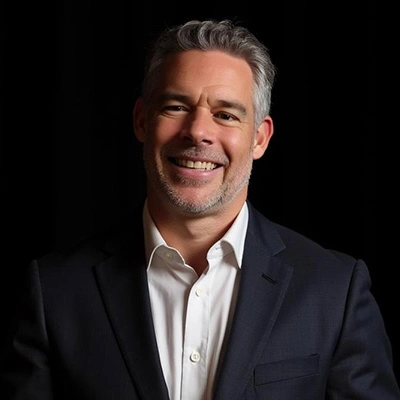


Telling Your Story Could Save Your Life with Aaron Donaghy, Story of Self


Over 20 years teaching high school, Aaron observed that his students’ lives and trajectories were effectively set by the time they graduated.
Frustrated by an education system he viewed as compliance-driven and devoid of meaningful agency, he left to work in addiction and trauma recovery. He began noticing recurring patterns: victim thinking, codependency, and a clinical culture that prioritized diagnosis over genuine identity change.
He became deeply interested in story, narrative, and the question of how people change, eventually moving from traditional teaching into working with people in addiction, trauma, and the military using “story” as his main tool.
He began helping clients reframe how they understood their lives and choices. His work ranged from addiction settings to high-net-worth clients, reinforcing his view that external success does not resolve internal struggle.
He later became outspoken about flaws in the modern treatment industry and developed story-driven, neurologically informed recovery approaches.
As the owner of Story of Self, his goal is to help people move from victimhood into purposeful lives through identity change rather than symptom control.
GUEST
AARON DONAGHY
Owner of Story of Self
Aaron has over 30 years of experience in leadership development, holds an MA in Leadership, and is the owner of Story of Self recovery programs. He is an international speaker, trainer, and coach working with leaders, athletes, and people in recovery.
Learn more about Story of Self
Follow Story of Self on Instagram @story.ofself
Matt Handy is the founder of Harmony Grove Behavioral Health in Houston, Texas, where their mission is to provide compassionate, evidence-based care for anyone facing addiction, mental health challenges, and co-occurring disorders.
My Last Relapse explores what everyone is thinking but no one is saying about addiction and recovery through conversations with those whose lives have changed.
For anyone disillusioned with traditional recovery and feeling left out, misunderstood, or weighed down by unrealistic expectations, this podcast looks ahead—rejecting the lies and dogma that keep people from imagining life without using.
Got a question for us? Leave us a message or voicemail at mylastrelapse.com
Follow Matt on Instagram @matthew.handy.17
About Harmony Grove Behavioral Health
Harmony Grove delivers outpatient addiction and mental health treatment focused on wellness, creativity, and authentic human connection—providing a supportive space for healing that extends beyond traditional clinical care. Find out more at http://harmonygrovebh.com/
Harmony Grove’s IOP in Houston, Texas, is more than a program; it’s a lifeline for those ready to take the next step in their recovery. We are ready to meet you where you are and find your unique path to change.
If you’re feeling overwhelmed or struggling, you don’t have to face it alone. Reaching out for support is a sign of strength, and help is always available. If you or anyone you know needs help, give us a call 24 hours a day at 844-430-3060.
Host: Matthew Handy
Producer: Eva Sheie
Assistant Producers: Mary Ellen Clarkson & Hannah Burkhart
Engineering: Chris Mann
Theme music: Survive The Tide, Machina Aeon
Cover Art: DMARK
My Last Relapse is a production of Kind Creative: kindcreative.com
Aaron (00:00)
And it is a beautiful story of a boy who's lost, who has to walk and face many dragons in order to find his way home to become the good father. Well, Matt, isn't that the story of every man today?
Matt (00:12)
That's crazy. I have tattooed in Latin. says, here there be dragons. I'm Matt Handy and you're listening to My Last Relapse.
Aaron (00:22)
I tell people with story, if you think people are boring, you're not listening. And so with authenticity and the difference between a scripted, these are the points we're gonna hit versus let's just see where this conversation goes. You're thinking about what's happening next instead of what do you really wanna know? Because if you're really listening to someone, everyone has a story. And the truth is, those stories are fascinating because every person's lived this story and then the story that none of us have lived. And so that ability, I do think people might be entertained by the scripted, but I don't think they're as engaged. I think there's something about when you truly listen to people, what happens is the listener doesn't. NPR has that thing where they just interview people about their lives. They'll set up a booth, come in, here's a prompt question, talk for five minutes. When I used to drive to teach, I would have to pull off the side of the road sometimes, because I would just be sobbing. And it's just people talking about their mom or somebody who's had an influence in their life. Unscripted.
Matt (01:17)
Yeah
Aaron (01:22)
That is where meaning really connects. Again, you can give a speech at TED Talk and it can be interesting and insightful, but the key for us or for me is I'm older. I wanna be engaged. If I'm gonna give you any amount of my time, I wanna be in that space.
Matt (01:25)
Yeah. Yeah, for sure. So I've done a lot of prison time and I've met, first of all, some of the smartest people I've ever met. They're in prison. And some of the most interesting stories and just life events that I've ever heard of, they were in prison.
Aaron (01:57)
And what made that, like, so you being in that space, what made that engaging for you? Like when you're there and you're meeting, clearly, you know, these are people intelligent, solving life problems, just not by the rules or by the rules that they can play by. But what was it about that experience that sets apart from the everyday experience?
Matt (02:17)
So prison in and of itself is its own world, right? And so my first time in prison, it was like, I can't believe I'm here. The criming world is a secret society. And back in the day when I started doing drugs, it was a secret society. had to know people, right? There was connection involved and not just connection, but if they didn't trust you, they weren't gonna sell you drugs, right? It's different today, because people are selling drugs on Facebook. And so, it was like an even deeper level of that secret society. And then I was 19, so I was really young, everybody was, I mean, literally, my first yard that I was on, I was the youngest person on the yard. And so it was just all of these older people, and then they were a part of organizations and gangs and stuff like this that. We're legendary, right? In California, there are big names, neighborhoods, organizations where it's like, I can't believe I just talked to somebody from that neighborhood. This neighborhood has a longer history than most organizations in the country, right? Most companies are not as old as this gang is. And so when you know the history and the story, and then when somebody who's in prison for 25-day life, they're there because of gang-related situations or whatever. They're a piece of that story, right? Maybe they're not an integral piece, but people on the streets are talking about this person. And I'm talking to this person in prison. They'll never see this guy again. And I'm in here talking to him. And so I've walked away from certain experiences and certain conversations in prison with a feeling of I just participated in a piece of history.
Aaron (04:10)
An alternative piece of history because these are parallel, right? It's secret, but it's really a parallel culture that self-assembles, has its own narratives, its own cultures, its own rights and rituals. So now looking back at that, you I know you've talked to Curtis and this is a lot, I'm always fascinated by his experience in that world. I haven't been in that world. How do you now look at this world, this normal world versus this alternative world? And do you see the parallels? you see like what keeps them separate? And what do you draw that comes into both of those?
Matt (04:43)
Yeah, so there's two big lessons that I've learned for myself about myself because of my experiences is that I'm willing to do and have done things that the average person would never even consider. And so in and of that by itself, I know I'm capable. And so there's that piece, but then also there's this part of me that was, there's a part of my manhood that was developed in a place that most people never experience, but also there are morals and values within those structures that when people look at a criminal, they would say that they have no morals and values. When I look at that, say they have more morals and values, they're just different than what you think are morals and values. And so is there morals and value systems? Absolutely. Do I think that people bind to them more, because it's a life or death game. Sure. And so, ultimately, what I have found is that I am able to dedicate myself to things more completely than the average person because of the experiences that I've had. Also, I'm never taking a chance with my life by taking a chance on the streets, right? It's like, I know that if I fail in this venture, nobody's gonna take my life over. And so I'm like, what are the actual downsides to this? Like I tried something and failed. Whereas in there, it's like you're playing on a whole different high-stakes game where it's like, well, if I've done that and was willing to fail in that, then I'm definitely willing to try this out here.
Aaron (06:20)
Right, right. And so in terms of that structure, what is the value that you could pull from that? One, it's the fearlessness, right? The biggest thing for me in facing a risk would be shame. But now that I'm older, you just kind of like, you you hit 50, you just, yeah, it's just like, what, this is all, this whole game is just BS. And so I think you learn that faster, you know, going to prison is just like, but it also feels like there's this part. So like,
Matt (06:37)
There is no shame.
Aaron (06:49)
what is the key for you if you go into a system where as the vast majority of people who leave that system are gonna recidivate, right? They're gonna go back. So what do you see is the difference for that solution? Because you went into the system, you were unsuccessful in society early on, you found a way to survive the system within prison, but then you come out and now you have this kind of mental concept in a world that does not operate on that mental concept.
So where do you think you found success where others so often just go back?
Matt (07:22)
Okay, so I went to prison three times. first time was super fun. I had a blast. the second time I kind of had some situations where I kind of second guessed it. And by the end of it, I was like, I never want to do this again. And the third time I was like, I never want to do this again. Right? So there's that. But first of all, there are things that are valued in the prison system that have almost no value here. Your word, right? Like when you give somebody your word, you're held to that. Whether or not you want to participate in whatever it is you promised or not, whatever it is, right? There's a lot of things in there that like, if you put your word on it and you don't stand by it, there are consequences. Out here, everybody's lying to everybody. And then there is a level of, so we live in 2026. It's January 9th of 2026. There is no coming of age for men anymore. And there is no, other than like the arbitrary 18, there is no, now you're a man. When I went into prison the first time, I was a boy, like effectively. I was 18 on my way, 19 on the first yard. I came out a man. I really feel like I grew up a lot. I matured. I learned how to hold my tongue. I learned how to speak when I needed to.
Aaron (08:24)
That's absolutely true.
Matt (08:52)
I learned how to stand up for myself. There was a lot of things that I took out of that experience that really evolved into the man that I became. But out here on the streets, there is no turning point in the evolution of a young man's life that says, you're a man. And so there are things that I took out of it that it really helped my evolution into. And like I said, three prison terms, 17 years of heroin use. It was a long process to get me to where I am. But where I found success, and this is a big thing that I talk about in addiction a lot, is that most people are robbed of the full benefit of their suffering. And so I let my addiction run to its logical course. Like, it was either gonna kill me or I was gonna age out of it. And right now I'm reading a book by William, do you know who William White is? William White of the Recovery Research Institute, he ran it for a long decades.
Aaron (09:32)
Absolutely.
Matt (09:52)
He's now in poor health and he's older and he's kind of hand the baton off to Dr. Robbins, but he wrote a book called Slaying the Dragon. And in that, he talks about basically it's the history of addiction and the treatment industry, right? And in this book, he talks about like the transition out of the field of addiction and into the treatment industry, a bunch of stuff, right? And one of the things that I have kind of gleaned from it and seen for myself is that most people's, the crux of most people's intense addiction is no longer trauma. A lot of it is codependency and enabling, right? That becomes what they're continually using over after the trauma has been covered. And so I didn't have that. I'm the oldest of 10 kids. I was alienated from society and from my family and all this stuff for over a decade.
I didn't talk to any of my siblings for over a decade. Didn't talk to my parents for over a decade. I didn't have a codependency based relationship with anybody that said that I could call when it was raining or I could call when I needed 20 bucks or anything like that. And so I really, really got to experience the completeness of my suffering, but then also had to deal with the consequences of my actions. Most people, whether it's family members, friends, whatever, they have people that will intervene on the consequences. And so what ends up happening is the codependency and the enabling becomes such that they are manipulating, they are enabling, and that becomes the pattern. Instead of the use, abuse, sorrow, use, abuse, sorrow, it's codependency, enablement, manipulation, codependency, you know, and it just continues this cycle versus this cycle.
And so it takes addiction and puts it in a whole different framework, right? Versus, you know, I ended up homeless, robbed the bank, like all of these things. There was nobody, mean, nobody was gonna pay for my lawyer, right? â So the bottom line was my addiction ran to its logical end. By the time I was done, I was actually done, right? There was no like, like as I sit here today, I can fully invest myself 100 % because there's none of that 1 % of my mind that's like, I wonder if I can still slam heroin on the weekends. Right. Right. It's like, whereas I think a lot of people, and you see this in the rooms, there'll be like that dude with 30 years sober and he's like, well, I just didn't drink today, so today was a good day. It's like, dude, I would be fucking miserable if that was what my existence ended up being.
Aaron (12:39)
It's just not doing something. Well, to me, like, if we look at this through narrative, that, let's combine the two thoughts. You said, when we look at your story with prison, what we see is a boy who becomes a man. That's how you're narrating it. But what we also see is it's a rite of passage. So in story, that's the death and the resurrection. So what has to happen is the death of the child. And so when you go through prison, you get separated from your world, even though it's a secret world. It's it's really a world that you're not in control of but because you're 19 You think you're in control of it, but you get separated and you go in and you get integrated into this boys club Really a men's club what you said strong morals strong values a strong system of respect Do not lie the funny thing saying is is we see the contrast outside of that is is you can lie but you also talk about codependency or trauma like there's things there that are Serious problems to this rite of passage. So you go in you're like, okay, well, you go into this other world of prison, then you leave it, you go back. So there is growth, but no transformation. Then you go back and then you're like, oh, this isn't as fun, same world, but now you've shifted and it shifted, same world. Then you go back the third time and you're like, yeah, now I don't like this because now you've seen that you've shifted and now you have to make a choice. So what happens is a rite of passage involves a separation. You leave your world, a liminal space, prison, it's this other world.
Matt (13:58)
Yeah.
Aaron (14:06)
But there's something that you've done differently that I think is critical to like what you're saying, which is integration. You've reintegrated and said, this is the world I wanna be in now. And so why am I asking you, you have this ability to articulate both of your worlds distinctly. But what we're talking about in with people who leave prison and go back or addiction, it's so funny how quickly your brain associated those two things. Because the same thing is true in addiction because they can go to treatment, they can go to a therapist, they can go to AA.
And those all have value because they're other worlds. But the thing is, is like your second stint in prison, if you don't go and you don't find the shift, if you can't transform, what happens is when you leave, it's just not doing the old behaviors because there's consequences. But what you said is there's a third step, which is this integration piece, which is this decision to become a new person. And so what's happening in this is with codependency or let's say, let's use both. This is where trauma and codependency have the same result.
Trauma gives me an excuse of why I can go back. Like, you know, my parents, I haven't talked to my parents in 10 years, society doesn't love me, but prison loves me, so I can go back. That's actually very logically, it makes sense. Yeah, yeah, it just, well, where else are you gonna go? Because you have nothing else. So I can go to a place where I know the rules, I know the game, and I belong. Or I can come out into a world that's lying, cheating, and stealing where I don't belong. And by the way, doesn't want me.
Matt (15:18)
Yeah. Addiction to they'll lock me up for the same things that they're doing. Absolutely.
Aaron (15:38)
Yeah, of course. And so like now it's like, them, these are my people. But addiction has the same quality where people leave. And I'm not an addict. So this is all coming from my last five, six years of just observation, but the same thing happens in school and work and in society. The same things happen where what we're doing is we're, the pain of transformation is so great. What we do is we try to buffer it Because we're a McDonald's Amazon society of like, well, how can I make this better? So we, we interrupt the process of rock bottom of like, transformation is painful. Like you said, suffering is a requirement to transformation, but people don't believe that because we have pills for everything, but we don't. And so what happens is, is okay, you're gonna come out and now I'm gonna, I'll give you a house and I'll give you a car, let's get you a job. Let's solve all those world problems. But we didn't solve the internal problem. So like even in IOP treatments, is where Nick and I are adamant about what we're doing is, if I talk to IOPs, a lot of the work that they're doing is how do we help people reintegrate? No, no, no, no, it's transform, then they can figure out how to integrate. But if I'm, you know, if I keep wiping your butt, you're not gonna learn how to do it yourself. And so this codependency is stopping the transformation because we're saying like, I know the liminal space, this in-between space is painful and you're adorable, so let me help you. No, no, no, no, no, no, that can't help you. You have got to face death and decide, is this where you wanna stay?
Matt (16:40)
Yeah.
Aaron (17:06)
Or do you want to move? You've done something very significant. Curtis has done something significant. Anyone who can find that sobriety and say, this is the life I want now, that is transformation. Because they've changed and now they want their world to change. That's why you see so clearly the man that's sitting here versus that 19 year old. Those are two completely different people. I mean, he's still you, but he's just a younger version of you. And if we don't allow prisoners or addicts or people with mental health treatment, if we don't allow them the pain to transform, it's just not going to happen.
Matt (17:36)
Yeah.
Aaron (17:38)
So what do you think it is for you? Like this is the stuff, this fascinates me. What do you think it was in you that allowed, I know the suffering, but what was the decision? What did you want that was better than the suffering? What caused you to shift? Because there's gonna be a moment where you're like rock bottom, but then hope. Something's gonna come up like, I need this to be different. Because that was impossible 60 seconds before that. So what was that?
Matt (18:01)
Yeah. Is that for you? Okay, so it was a series of realizations, right? So first, let me say this. I always tell people that addiction should work the same way as an abusive marriage. There should be a honeymoon phase, then there should be a use and abuse cycle, and then the divorce phase where you fall out of love, it's confrontational, but you can't leave each other.
And then there needs to be a definitive moment where the separation happens. So the falling out of love and the divorce phase is where most people get interrupted. And so they continually just stay in the use and abuse phase because they've been completely babied around the hardest part of it. my divorce phase was years long. And what ended up happening was the drug stopped working and I tried everything I could to make it work again, just like an abusive marriage, right? I tried for years to get this to work again, to get it to work again, to do more, to do it differently. Instead of intervenously, was gonna like muscle it. Instead of muscling it, I was gonna smoke it. Instead of this, I was gonna, and it wasn't like, it wasn't the, â I'm going to control this. I needed this shit to work again. It didn't work again. And so then the like, maybe the last two years of it was, I have got to get out of this.
Something has to change and the only thing that will work is if I stop doing this. Now, how do I stop doing this, right? Which is ultimately the abuses biggest problem is how do I get out of this? Right? And then this is a question that I've been asking myself a lot lately is can I abuse inanimate objects? Can I abuse a hammer? Can I abuse a door? Can I abuse a table? Can I abuse drugs? Or was I abusing my, I was switching the framework from I was being abused, or I was abused to I was the abused in the situation. And so ultimately what it comes down to is I cannot abuse drugs. You can't abuse them. I was abusing myself. So I switched that framework. It was just a series of realizations like this. And then obviously like, the biggest, pivotal moment in that divorce phase was my last arrest because it became very, very obvious to me very, very early on in that divorce phase that I wasn't gonna be able to do it. Which a lot of abused spouses also come to that very quickly too. And so they have to be rescued in some way or another. My arrest was not an arrest, it was a rescue. And thankfully, you know, my higher power, which is my God, whichever, whatever that is, right? Really gave me a good wake up call with that too, because I was arrested and was looking at doubling my lifetime in prison. But then he also gave me an out, where I didn't have to go do that, right? But he also let me look at that and sit with it for a long time and say, this is the reality that you will face if you don't change, right? You're gonna end up doing the rest of your life in prison or you're gonna end up dead. And I was like, okay, very easy for me to say I don't wanna end up dead.
It's a lot harder for me to say I don't want to end up in prison, but it is much easier for me to say that I would much rather not go to prison, right? Because prison becomes a very safe place for a lot of people really quickly. So it was just â being able also the solitude of sitting in a, I was in, this was in December after COVID hit. So December of 2020, I get arrested. There was no day room. There was no yard. There was no none of that. A lot of solitude in my own self, sitting with my own thoughts, not interacting with other people, really making decisions around, am I gonna, and then one of the last things the judge told me was, I'm gonna give you the opportunity to save your own life, or I'm gonna lock you up for the rest of it. If you fuck this up, I'm gonna lock you up for the rest of your life. And so just a bunch of things were put in place for me, but then also those things that were put in place allowed me to really sit with it and say, I don't wanna do this anymore.
Aaron (22:19)
Right, so it's a very critical thing. So there's two things that are happening there too. It's our external world and our internal world. So you have all these external pressures, which by the way, you've had for a lot of years. And then you have this internal pressure, right? It's not working anymore. You've been to prison before, you know the consequences. So there's the knowledge that you have from your experience. But there's something else happening here where you're sitting in that cell. I'm alone, I can't move. It's you, you mentioned your higher power. Like there's something that's shifting inside you. If you look at that moment, what did you begin to see differently as that version of you that you couldn't see before? Because all of this has been presented to you. It's not like you lack the knowledge that you were on a path towards death or prison, right? Addicts know where they're going. Yeah, for sure. One of the first lessons I learned from an addict, I still remember this driving in a truck, I'm like, what happens if this doesn't work, this treatment? And he goes, there's three places for me. I either go back to rehab again,
(23:16)
He goes, I go to jail or I die. He goes, those are my only three choices. And so as a non addict, I'm like, man, that's a heck of a way to see life. And so for you, you're sitting in death, a death you know well, but something shifts inside you with you and your higher power that you began to see something different. I know the choice was presented to you and that's fate, but again, that's an external. What shifted in you? What was the piece in you that changed?
Matt (23:23)
Yeah Yeah, so let's see, I was 30, right? And I had always, there was a piece of me that always knew that I had to quit. And so when I was nine years old, was eight or nine, I walk into a bathroom and I see my uncle shooting up, right? First exposure to this ever. And somewhere deep inside of me, it wasn't even that deep, I knew immediately I was gonna do that someday. And as time went on, I knew I would do that, but I also knew that it had to stop. And so with that knowledge of it had to stop, also, that thought process also evolved into like, why do I stop? What are the things that are important around why I'm gonna stop? I got arrested three days after Christmas of 2020. The day after Thanksgiving of the same year, my girlfriend at the time, who's now my wife, told me that she was pregnant and that she was leaving me because I was dangerous. I was gonna get us killed, right? And she was very vocal about this. Like, I can't be with you right now. You're fucking crazy, right? And so in my head, I'm like, what are the things that have to be in place in order for me to make these changes? Ultimately, this is what it was. So a couple of other things were also put in place where like the decision that I made to completely be disconnected from my family was this, that â my family has addicts in it. I'm not the only one, but there is an open agreement, right? If you're actively using, you're not invited. But if you're not actively using, open arms. You just have to have your clean. So I knew that there was that one year that I had to do, which I knew it was gonna be three years because of what was going on with the courts. But then also fatherhood is something that I'm the oldest of 10 kids and my dad is my hero. And so I knew that there was this little person that was gonna be born that if I couldn't step up to that responsibility, there was no hope in like any of what was about to change, right? So again, external pieces, but really the internal change was that I need to do this not just for that kid, but for myself, because I know I can fail, right? But I've never succeeded at anything. And so the desire to succeed helped propel, like, so discipline and dedication. I talk about this all the time. I didn't have any discipline, but I was a very dedicated person. And I believe that you can be dedicated until you're disciplined or disciplined until you're dedicated. So I had one of those pieces and I was like, I think I can do this, right? I think I can do this because I can be dedicated enough till I'm disciplined.
Aaron (26:34)
Well, what were you dedicated to before that and what were you dedicated to after that?
Matt (26:37)
I was dedicated to the change, right? Ultimately, I didn't know what fatherhood was in practice. I just knew what it was in theory, right? And so, the only thing that I'd ever, I was the oldest of 10 kids, I'd helped raise all my siblings, right? And so the only thing that I ever wanted was to be there for one of my children's birth, right? And so at this point though, I had already lost a marriage and lost a kid. And so I already knew,
I was gonna not be there for this childbirth. I wasn't gonna be there for however long of this child's life. And I was like, I can't do this again. And so a lot of the internal mechanisms and changes that happened were around the desire to experience fatherhood. Now, as far as acutely answering your question, what was it that changed? I think a lot of it had to do with my extreme desire not to repeat the same things that I had already done.
But also like there was like an ember of that fire still in me that like I knew I could do it if I really really put my mind to it right and I had failed at everything else, right? Basically like I sucked at being a drug addict because look at where I ended up I sucked to be in a criminal because look where I ended up I sucked it being a gang member because I got caught like There was all these things that I had done that I I knew I could fell fail up. I've done it many times now can I succeed? So that's really what was like I am going to do this and if I fail trying I'll just get up and try again. And I think that was really kind of what the internal mechanisms were.
Aaron (28:19)
I think it is key, because what you're saying is, is you had an identity shift in it, because look at how you talk about what was before and after. You talk about all of your failures. I failed as an addict. I failed as a man. I failed as a criminal. Now, but the language shift there is critical. This is why I think story is absolutely critical, because there's a language shift that is, it's like, what if I could succeed? That is a complete identity shift. You go from, I'm a failure to. I can succeed. And those are two different identities, but you had to come to that realization on your own because you've had marriage, you had kids, you've had success. But the thing that you identify is the failure because we look at our past. So like to play in story a little bit with you, what I see differently, I saw this in my students when I was high school teacher, did that for 20, 25 years, what I saw was my students were already predestined for their life by the time they were leaving high school. You know, we give them the cap, gown and in that piece of paper. But the truth is, it's not even a right of passage anymore. It's just like, do whatever your life or your culture or your family or whatever puts the expectations. If they have no expectations, we know where that's. If they have high expectations, we know where that's gonna end up. But the point being is still is the kid is already starting to write it on their soul that they're doomed. So here I am teaching photosynthesis or evolution and I'm like,
Matt (29:16)
Yeah
They won't do anything.
Aaron (29:45)
How does this change their lives or how does it give them ownership or be empowered in order to, like what you had in the prison was the opportunity to make a decision of where I'm gonna go next. And if you look at your life or we look at even a successful person's life, when do they have that opportunity? And that lack of opportunity for agency in your life creates an internal pain. I could be successful, right? I've worked in addiction for years. I've worked with people worth half a billion dollars. Well, is the next million really gonna
fill the gap and they know the answer is no, but they don't have any other choice but to pursue it because we seek external solutions to our internal problem. There's your, we live in a world of lies versus prison. Well, because why? Prison rip all that BS away. That's only true. This is pain, this is suffering and hey, everyone in here sucks. But I mean to society, but out here in society, we all suck, but we're all pretending we don't because we have Facebook and I can order something to make me feel better on Amazon or go get a cheeseburger, you know, like that.
But the idea is, is we're playing this game, we're all winning or losing, but the truth of the matter is, and this has been going on since, you for hundreds of years, that we're all losing. And that creates this gap of a pain. What I see, and what we're doing with story is this, all people, addict or not, I would sit in the rooms, you know, I'd go to work, I worked out here in Houston, I'd come in and I'd sit there and, you know, we would do the process group in the morning and I would just observe. Eventually I'd jump in. But what I would hear over and over again is how they were all victims.
They're all victims. And I'm like, own it. Like if you don't change, your life's not gonna change. But their mind was, well, if I quit drinking, then my wife will love me. I'm like, but you're not answering the problem while you're drinking. Like what is it about that? And so like in your story, here's some interesting things, One, you were the oldest of 10, right? Your dad was your hero. But at 19, this is a kid going to prison. So big family.
You've shown that you value family not only as a father, but you said, you know, if I get sober, I can come back. So you're speaking this high value of family, but this kid by 19 leaves his family, doesn't speak to him for 10 years. So there's a lot going on there. So my thing is, is I know drugs and crime, but what was the thing that, and I know you walked in and saw your uncle and you're like, I could do that too. But there's something in you that said that I'm that person. So in story, what we do, whether it's, you know, I work with military, we work with addicts, work with people with trauma. What is the thing that began the belief that you were a failure or that you were not somebody who could be the leader of the family? Where did that thought begin with Matt?
Matt (32:20)
Yeah, one of the things that I hear, I think it's the biggest cop out. And I'm sure you've, maybe you haven't heard this already or not, like, I speak out against dogmatic practices in the recovery industry, right? Well, yeah, yeah, yeah. People will often talk about the fear of success, right? And I think it's the biggest cop out in the world.
Aaron (32:36)
Gets people to walk out. Or dogmatic. Yeah.
Matt (32:48)
I also think that the fear of failure is a cop-out too. I could point to being molested as a kid and say that there was a fracture. How old? It started probably around four and went to five or six. And it was multiple times. It was an uncle. And there was a lot of self-doubt in that as well, because I was molested by a man. So there was like that whole identity around like, you know, is this gonna affect my sexuality? Like, what is that, right? So having to tackle that â with a juvenile mind. Of course. So I could point to that. I could also point to being the oldest of 10 kids and not having the oversight or the continuity of like relationship that I needed with my parents. I could point to that and say that that was a reason or I could point to there's a slew of things that I could point to that you will hear people constantly point to. But I think it's all bullshit.
Aaron (33:53)
Well, can we push? Because I'm gonna agree and disagree. Because I think I'm someone to be blunt, like, I'm not a fan of trauma. I think that Oprah Winfrey generation, it becomes what is markable in a 45 minute show of like, well, ain't it awful? We love that ain't it awful. And it is awful by the way. Unfortunately in the work that I do, molestation is massive for men, for women, obviously for women, but like men keep it really well tucked away as well. But there's something else that happens there. And so where I do agree is we've become a society that hones in on that. In CBT and DBT and all these practices, they're effective at what they do, which is like, let's analyze or diagnose. The problem is it doesn't solve. And the thing is, you know what does solve? It's gonna solve the pain.
Matt (34:44)
And it's really good at what it does.
Aaron (34:45)
Yes, and it's immediate. in that moment, it's way better than therapy. Like, we're gonna do this for six months. Like, how about no? But if we look back, so you were a very young kid who didn't have the ability to process, this is a family member. How does that kid, when does it become a point where that kid realizes he's alone in this? Because there's the trauma, which is the act, it's the event. But there's an experience that Matt is gonna have when he's a kid where he internalizes that something's wrong with him.
Matt (35:19)
Yeah, so I, and this is by far not a critique of my parents, right? Sure, sure, sure. Cause they were kids when they had me, they were 19 and 21 when they had me. So they were effectively children too. But I learned very early on that I couldn't trust my mom. So in and of that concept by itself, I was already alone.
Aaron (35:43)
Can you come up, forget all the other stories we did. I'm gonna play story with you here for a second. Do you remember a specific time when you had a conversation or an experience where your mom, where that version of you, that young version of you knew? It's a specific memory. Like it might seem like nothing like, mom, can I get some Cheetos? No, but it's a specific memory with a lot of detail that said like, that was the moment where that kid understood, I can't trust her.
Matt (36:10)
Not a specific memory. It was like again, a series of, this was the early 90s. so child abuse was defined a lot different and discipline was looked at very differently. And so by today's standards, like they would have been in trouble. Sure, sure. Right? And so it was just a long series of events that like basically said that like, these are these are the people that discipline me. They're not the people that protect me.
Aaron (36:46)
But specifically your mom. Like, you know, with your siblings, sometimes you'd be like...
Matt (36:50)
Like my dad. Yeah, actually, yeah. My dad, my entire growing up, until I was 13, so like my entire childhood, he was in school or working. My mom stayed at home. But my mom wasn't who disciplined us. My dad was. So it was when he was done with a long day at law school, before he would go on his lab route, one of the things that he had to do was look at the board and see how many spankings, however kid, and...
When I realized what was going on, I think I was probably seven years old. I just remember thinking like, why do you do this for her? And that was the thought.
Aaron (37:37)
Right, so in that, so now when that kid, he's only seven, I mean, seven is young, in second grade, when he has that realization, now he can't go to his dad or his mom for an answer, so he has to go internal. What does that kid, what shifts in that kid? I really want you to think looking at that board and seeing, you your hit list, legit, when you're looking at that, what does seven-year-old Matt decide about himself in relation to his parents? Who does he become in that time?
Matt (37:58)
Yeah
Aaron (38:06)
Like what does he begin to believe about himself when he says.
Matt (38:09)
Yeah, yeah, so I actually talk about this in a roundabout way all the time is that I learned that there were things that I had to do, like there were obligations that I had to fulfill. And that as long as I have fulfilled these obligations, I could do whatever I wanted because there was no oversight, right? And so by the time I was 15, 16, I was living a double life. Right.
Aaron (38:34)
That's your solution. That's your solution to the pain. I want you to go back one more step and go back to him because he's accepted in a reality about himself, which means he's made a decision about him. What does he learn about him? Who does he become in that moment that he wasn't before? His dad was his hero, but in this moment, you're like, why does he hit me for her?
Matt (38:44)
Yeah, yeah. Yeah, it was still blamed on her. was like a placeholder. Still, can still remember, this has nothing to do with... Because he was mad that he had to do it, right? And I think that that also played into how intense those exchanges were. But, â okay, ask again, ask the question again.
Aaron (39:18)
Let's even go back one step further. I want you to go to the realization that there's literally your mom's putting a hit list on you and you're looking at that and you realize that your dad's compliant. What does that feel like for that kid? When you're thinking about that memory, not the external of it, like telling the story to your brothers and sisters, because we will laugh about that. Remember mom and dad? That used to be funny to us because it was normal. But what did that kid, that seven-year-old really feel when he realized what was happening? What was the feeling he experienced?
Matt (39:45)
Yeah, again, I think it was like a bunch of series of things where it was like, I realized that, again, I had to satisfy certain things. so- Solution. Oh, this is what it was, that I effectively could lie. I don't know why this is, probably because I was seven. Yeah. But the outcome of it was I needed to lie. For whatever reason, I don't really know.
Aaron (40:10)
Because why?
Okay, so there's part of this that one, he's a bad kid, right? He's like, don't, but inside there's an identity. So when we deal with trauma, we deal with the event, but this is the work that when I'm working with people, we gotta push them underneath that because the brain, the language part of our brain is in our, our auto, right, our cerebellum, all that stuff on the outside, but on the inside is our emotion. Those are two separate parts of our brain. So you're articulating the events well. This is what I chose to do next. No, no, no, no, no. Go back to the kid looking at that board.
(40:42)
You know, that realization, that moment when he realized his mom is telling his dad to hit him and his dad's just complying. So he now feels, what is a kid like that gonna feel? What does it feel like to be that kid? What was the-
Matt (40:55)
What is the feeling? Yeah, the feel. Yeah. Yeah. Yeah. It hurt for sure But there was a lot of fear, I guess
Aaron (41:03)
Fear right. Sadness? Because who does he go to with this?
Matt (41:05)
I think there was less sadness. Yeah, no, a lot of it was fear.
Aaron (41:11)
Okay, so he takes that fear and creates what identity? Because fear is gonna become a motivator, which is to lie. So he goes from fear to liar, because what he's resolved it to lie, because this is my solution to my pain. So he has the pain of fear, right? Like, there's no getting out of this, except for if you become someone else. So there's the adoption of almost like I'm a bad kid. And by the way, those hits, using one of your words that you talked about when you were sitting in that jail cell was failure.
Matt (41:33)
Yeah, no, for sure.
Aaron (41:39)
It's like she's marking your failures and then he's creating fear around that to hit you. So notice how we can take away the trauma. look at, we just went from all the abuse of your uncle to a moment where your mom is telling your dad to hit you. It wasn't even the hitting. You see, like we know the hitting. Like my dad was very physical. I grew up obviously even before you. Different. Right. Don't spare the rod, you know? And actually those, my parents or that generation of parents and my parents were immigrants. So they were told like, don't hug your kids.
Don't be overly affectionate, don't be supportive of them. Because they said you're gonna make them weak. You know, fair enough, two world wars, all that. The thing is, it's like toughen your kids up. know, my dad, be a man or a mouse. Those are the things, you don't like it, there's the door. It was very, very, very structured in that way. So there's this isolation, right? When my dad came home, it was always fear. So there's that fear, but I knew him. I knew what it was to be hit. I knew what it was to even fear him. But what becomes is our solution and the gap of what it is.
But we see it seven years old, here's a kid who's living in fear and finding a solution like, well, if I'm gonna be bad, I'll find a way around it. Which by the way, by 19, you're perfecting. So then it's like, well, if I'm gonna be bad, I'll find a solution. And you said, oh, I failed as a criminal, but that failure as a criminal means you were also seeking success, because you're seeking a solution. This is a guy who loves his father, loves both of his parents, honestly, you're respecting them, loves his siblings, loves family, but now he does feel on the outside, that fear isolates him, it makes him different, that there's something wrong with him. So he now is mapping to be something else, which is a liar. Like, I'm gonna lie, I'm gonna manipulate so that people don't see what I really am, because the person I really am gets put on a hit list. That's that split you talked about. There's a division of your story right then, which is this is a kid, because the spark inside of you is somebody who wants to love his son. You want family, but that kid, would you ever put a hit list up for your kid? No. No. Could you imagine?
Matt (43:35)
Two daughters, so.
Aaron (43:37)
But still, right? Did your sisters get hit? No. that's open. Yeah, yeah. yeah, we all got whooped. So...
Matt (43:40)
No. Well, you gotta figure, we have 10 kids. By the time the girls were born, they were fucking tired. They were like, dude.
Aaron (43:53)
Yeah, yeah, yeah, of course well, that's what happened with my little brother as well So what but that little identity like that small shift in identity like you said your word was I became aware Which means we've opened up our eyes that kid begins to see his world as him against it and it took him to You said you were in jail when you were 30 sitting in jail. Yeah
Matt (44:15)
My last arrest happened six months after I turned 30.
Aaron (44:22)
Okay, so we've got 23 years later, he's sitting there and going, I don't wanna be this kid anymore. And that's where it begins to map. Because there are parts of your, what do you remember loving most about being a kid? Like if we go to your happy childhood memories, like what was your favorite thing about being a kid before seven even?
Matt (44:44)
Uhhh, probably my grandpa.
Aaron (44:46)
Yeah, what was it about him?
Matt (44:48)
Safety. Plus he was just, okay, I realized really young that my grandpa was kind of like a player. had this redhead â secretary and then he had the hot Mexican wife. And he was like an older guy that got divorced and then married this young Mexican lady. So yeah, always looked up to him. Pictures of John Wayne all over the place.
Aaron (45:14)
When you were with him, like, give me a story about you and your grandpa. Any story.
Matt (45:18)
Okay, how about okay another was that he was kind of like bad, you know I found a gun under his bed one day and I was like, shit, you know, He had like he had like an old sport he always had a sports car so he was like cool.
Aaron (45:32)
Right, but when you were with him, what was that like? Yeah, but you also said safe.
Matt (45:35)
It was always fun.
Yeah, very safe. But that's why it was fun too.
Aaron (45:40)
Yeah, so safe to have fun, right? Like, so that feeling of that, but when your mom is putting your name on the board, that kid is not safe. Right. So what we see is in our internal values, there are things that are always coming in conflict. And so with people, we have to understand what's really going on underneath it, because trauma is an event. So two people can have the same trauma and then resolve it differently. Two people can go to prison and come out of it totally different. For sure.
Because it's not the event, it's the experience of the event. But oftentimes when we're treating people like CBT on all the science that's behind it is often like, well, let's resolve the event. You can't resolve an event, right? You can't change what happened to you as a kid. You can't, all of it. But what you can do is re-narrate the experience. What is really hard that I've found dealing with hundreds of stories is the fact that you can't resolve it if you can't resolve the identity. So when people are molested, the molestation is terrible.
What really affects them after that though is the identity. They couldn't go to somebody or they told their friends and their friends were like, don't tell anyone, no one will believe you. Where they tell their parents and they're like, that didn't really happen. So then all of a sudden it becomes an unresolved experience. And what the person does is naturally adopt the identity. You know, know your dad loved you, but you feared him. And that's a hard thing to resolve. So the seven-year-old kid is gonna attempt to resolve it. And like you said, if there's no right of passage, you know.
Matt (46:47)
Yes.
Aaron (47:05)
So you go to prison and you find strong men with strong values that believe in you. And that becomes awesome, right? Except where is that gonna take you? And so you had to get to a point where you face death, the cave, you're in a prison cell and you're sitting there by yourself and you're like, I have to make a decision of this, am I bad or am I not bad? Because a bad Matt, a Matt who deserved to be in pain, a Matt that's mom was punished.
Matt (47:13)
For sure.
Aaron (47:32)
Putting the punishment and the father, right? Symbolically, you're doing this. Well, society has been doing that to you for 20 years, but until you came to the resolution internally that you didn't have to be that, you chose away from that kid. You said there was a spark. Literally your word was there was a spark that made me believe, an ember, that I could be different. I could be a good father. And the thing is that is deeply symbolic. You even said, I don't know what that means. But the thing is it's a call to a better version of you. And so my contention in treatment is, or even in prison rehabilitation is, we're not gonna help people by giving them a home. I met a guy in San Antonio, his job was to go and connect with homeless people to try to provide them housing. He says, but there's steps, like one, you gotta get them to say hi to you, because there's loads of reasons, from addiction to mental health, to just circumstance that they've ended up homeless. And so in our mind is like, well, homeless people need a home.
It's just like an addicts just need to stop. But when I was talking to him about story, what I said is, is I'm like, okay, let's say you solve all those problems. He goes, sometimes you just gotta get a â cup of water. If that's all they want, that's all we give them. But I'm like, okay, let's say you get them on a home. I said, what is the average length of stay of someone once you house them? Yeah, he said about two weeks. He said they'll go in there and they don't know what to do with it because they're solving the housing, but they're not solving what caused the homelessness. And so,
Matt (48:48)
months.
Aaron (48:59)
It's like addiction. like, well, just stop drinking. Thanks, Nancy Reagan. Let's go with that. But that doesn't solve what's underneath it. You're a kid that from seven to 30 didn't know how to solve the problem of fear. And you solved it by becoming criminal, hyper masculine, right? Because you became, it's called defiance. I'm going to prove to the world that I'm not afraid, right? I'm going to face death. I'm going to do heroin. But the thing is, is all of that stuff was a false solution to a real problem.
But it isn't until you became this version of you that is like, I am not that person. There's a new truth that you replaced. And since 30, what you've done every decision is to make a decision to prove that person wrong. So you said, I'm not gonna be a failure, I'm gonna strive for success. Because now what do I have to lose? And now you have this amazing insight to be able to look back and adjust that story. And if we can't do that for people in addiction, what we can do is we can tell them to stop drinking or they can, go to AA and they can sit in that one room that you is. And I know that there's a lot of good stuff that happens in AA, but there is the things where people are like, well, if I, you know, I'm just gonna not drink today. And well, that's again, addressing the problem, but not creating the new identity and the solution. That's the spiritual transformation because anyone who would believe in any type of God has got to believe that that God sees the holy in us and wants us to be on purpose, not to be in pain.
And if we don't find the thing that can bring us to purpose, the story that has purpose, all we're doing is pain avoidance, which, again, there's plenty of solutions for that. But we can't be a society that avoids suffering. We can't be a society that just looks and says, I don't want to feel pain.
Matt (50:36)
I mean, look where we've ended up.
Aaron (50:39)
Absolutely. And it's continuing to strike. We have a crisis with men.
Matt (50:44)
Yeah, the epidemic of silent suffering. â
Aaron (50:46)
It's, it's not even silent. We're ignoring it. You know, there's a stat that says more men have died since COVID of overdoses, of drug overdoses, and then died in World War II. How is that not front lines? You know, â the rates in suicide increase, the rates in young women who are cutting themselves because of social media. Like these are massive epidemics. It is demonstrating despair. Last year when Biden left, his surgeon general, you know, did his goodbye speech.
You know, and we've got post COVID, we've got cancer, we've got sepsis, we've got all of these diseases. And the guy goes, the number one health crisis in the United States is a crisis of meaning. That's what he said. Of all the health issues going on, the surgeon general says we have a crisis of meaning. And meaning means we've lost our story. You see it, because you see that even in prison, they can find a story. Now it's walled off. And so maybe that gives it advantage because they have to find some meaning there because it's so meaningless. But out here, we're finding meaning in what?
Purchasing and power and finances in Facebook, you know, and look at all the women in Hollywood changing their faces like you're famous and you're changing your face for what?
Matt (51:52)
Well, and then you can look at the trickle down to the average person with these filters.
Aaron (51:59)
It's all rejection of self. Because what do I value? Well, my value is what you think of me. Well, I'm 50, so that kind of starts to fade away. And we go through enough, and you've been through enough. I mean, you can see a transformation because you speak about your past with confidence. This is who I am, this is what I've done. It's just not who I am today. But we know we live in a society that when you say that, they're like, you know? And our beliefs, like the people who, when you say something that they does not, aligned to their belief system because what is happening is not only is my identity my filter, my belief is my filter. So what happens is if you say, well, can we take another look at, let's say, how AA works? no, no, no, you can't because it's an attack on that. Or I'm a Christian or I'm a Republican. These things are not real. They're identities that we're putting in front of ourselves because you don't even know what that really means. You only know what that means to you. And the question I really, we need to find in people is who are you really? Like who is Matt really?
Right, you know, he's a seven year old kid who loved his parents, but just ended up fearing them and had to find his own way. And it's a beautiful story of a boy who's lost in his head, who has to walk and face many dragons in order to find his way home to become the good father. Well, Matt, isn't that the story of every man today?
Matt (53:15)
That's crazy. I have tattooed in Latin, says, here there be dragons.
Aaron (53:20)
Of course, because it's what it is. And we're creatures in story, we're very good at dealing with the known world, right? We look at science, we look at data, and that has value. But what we don't do well is talk about the unknown world. And Matt, you said it beautifully, sitting in that jail cell, you actually made a decision to leave what you knew, which is dangerous, and go into the unknown. Now, people would look at your life and say, you're going to prison, and no, that wasn't dangerous to you. Even death wasn't dangerous to you.
What was dangerous was hope. What was dangerous was like being a good father, because you're like, I don't know and I failed at this. When you're sitting there facing failure, that is all new. And we don't, that sparked something in us, sparked something in me. And those are the stories that we go to, right? That's Lion King or that's Batman. There's all these stories where we want to become something more, but none of us know how to do it. And without rites of passage, without suffering, we're not giving people opportunities to change their stories, because that's what people want. I just want to live the best version of my story. Does it mean there's no pain, there's no suffering and that living on purpose every day is fun and easy? No, no, no, no, no, no. It's actually really hard. Being a father is really hard. Being a husband is really hard. But the thing is, is, now Matt has become someone who does hard things because he can face, you've faced heroin, you face prison, right? You face death. So the thing, like you said, is like running a business, like the only thing that comes along with that would be shame or the potential of failure. And so it's like, but why not face failure?
Why not?
Matt (54:48)
Yeah, nobody will take my life if I fail at this.
Aaron (54:50)
No, no, it's but but what comes of it even with failure is growth for sure and but we we fear that part of it and and we've become complacent in this middle space of just accepting life as it's given to us but if if forget god for a second if we look and just say this is it you know like i'm an atheist let's say i'm an atheist and i just think when i die i become worm beat but it still means i have this set amount of time which is undefined just to live my best story. So am I gonna give that story to a world that rejects me or a world that doesn't want me to be part of it? No, but we're doing that across the board. We're doing it with all people, men, women, kids, adults, all people. There isn't anyone, right? â you're retired, now you're useless. The number of men that come into treatment because they've retired, and so what do they do? They sit home and drink because now who are they? Well, I go, think who you were was 30 years? I talked to one gentleman because I always ask him their story.
So they give me 45 minutes. This guy, amazing journey, but everything he did was built around his job. I started working on his first thing. I started working when I was 15. I'm like, here we go. He has kids, he has an amazing wife, ranches, and he's had all this charitable work he's done, but everything was about work. And so I asked him at the end, said, when are you retiring? He goes, well, how'd you know I was retiring? I said, well, you just started drinking this year. It means you made a decision to retire. You made a decision to change and you don't know who you're gonna be when you retire.
And he's like, that's exactly it. And he goes, I'm afraid that when I stop working, my life has, I'm dead. So he goes, so I'm just drinking cause I'm basically ready to death. But whether that's 60 or 16, it doesn't matter. It's the same thing. Kids in high school are looking at the future and they're like, well, I gotta go this way. But they don't feel any choice. I had an amazing student. She was a soccer player. She was a top kid in the school, popular, all those things. And she had a decision between like U of M and this, think, Keatington, I can't remember, it's an engineering school, two top schools. So I'm just like, I don't know which one to go to. And so I go to the first one. I'm like, well, why do you want to go to college? And she just starts crying. She goes, I don't know. I don't know who I am. I don't know who I want to be. And it's just simple, but like high school kids are so raw in that, and like that they just like, I'm just going forward. Yeah. You know? And that's what life is. You get on a path and then there you go. And addiction is the same thing. They've got on a path. And so we tell them like, well, let's just stop you drinking or using, and then what?
Matt (57:18)
That's, yeah.
Aaron (57:19)
Now what, what am I? Look at what you're doing. Look at what you're building because you have now enacted this creative force. You've taken that one ember and spark and said, like, I'm going to confront the status quo because the world didn't work for you. So you're going to look at things naturally in question it and challenge it because the higher value is your grandfather, which is this guy who was bad, but really just challenged the status quo, right? He was cool. He was a player.
He had weapons, he there's a bit of danger there, but he was alive. And the funny thing is, is in all of the danger that was around him, he made you feel safe. And I bet all of what you're doing here is trying, I bet deep down is trying to create a safe place for people to change their lives. That's it. So it's safe, and then it's the transformation. Let's light the spark. And that's what we wanna do with story. Like you can't keep living the same story and expect a different result, right? That's insanity. And these people, I had a guy, we just finished a group yesterday, he's military. And three months ago in October, he put a bullet in his head. He's sitting in front of me doing story and this guy had put literally in my head when he first told me the story, I thought he said the gun locked up because I'm thinking who's gonna survive that. And then it was a week ago, he goes, no, no, no, it fired. He's like, I dropped on the floor. He goes, I saw the light, you know, and he's walking me through this. And in the moment I'm like, this is way bigger than me. But the thing was, was again, he was molested as a kid, but what it was was for him was no one was there for him. Like no one was there to protect him. And so he's always felt unsafe and alone. And so he's isolated and he joined the military to be a man. He's done all these things to like prove this. But even when he got in the class, his mindset was, well, I'm unworthy. I can't even die, right? My brain is mush now. You know, I've just got to figure out how to get by this. And he's like 23.
Wow. Yeah, it's really tough. But at the end, he stood in front of the group, he reads his story, and now he sees that he's the protector. He just felt unprotected. But I said, what was the first thing you thought of when your eyes opened up? He goes, my family. And I go, who in your family? Who in your family do you have to live for? And he goes, my brother, just like you with your son. He saw something external, but it awakened the internal in him that he didn't want his brother to go through what he's been through. And I said, well, then your leadership mentality your purpose is to create a world where people can feel safe and belong because he hasn't experienced that, but that's what he wants. I go, well, then we build it. That's what you're building here. You're solving the problem that that kid had, right? People will come in abused, but really now have to learn to unabuse themselves, which is a different way of looking at this, right? You know that. That's your superpower.
Matt (1:00:03)
Yeah, that's funny superpowers. I think that there are three real human super have you have you watched any of the show?
Aaron (1:00:10)
I saw the clips Nikki and Curtis had sent me clips. Okay
Matt (1:00:13)
Yeah, I think there's three real human superpowers. It's childbirth, high-level math, and recovery.
Aaron (1:00:19)
Yeah, yeah, high level math. Tell me that one.
Matt (1:00:21)
Well, I mean, I can't do it. And when you really look at like what monumental changes have taken place because of high level math, I'm talking about like space travel, nukes and Wall Street, IRS.
Aaron (1:00:39)
The economy, So link those three together. So you said something interesting there. So you got childbirth, math, and its impact, and then you have recovery. What do those three things all have in common for you?
Matt (1:00:49)
Well, I can't do two of them.
Aaron (1:00:50)
Well yeah. But they all have transformation. Yeah. You said math is about how it changes the world. Childbirth is massive transformation, as you know, and then recovery is transformation. And if you look at any heroic story, every heroic story is about transformation. For sure. Everyone. And so for humans, boy to man, girl to woman, marriage, death, these are all, how do we deal with life in its transformation? Because it's going to transform.
And so how do we deal with that? Well, it's a heroic act. And we've deleted the hero because we want people to be passive. I'm a teacher, right? Education is all about passivity. Like we're teaching kids to be passive, specifically boys.
Matt (1:01:34)
I just had a conversation with somebody that talked about the theory of self-domestication. I was like, they said something and I was like, wait, I think I agree with you based on the definitions that I'm gleaning from what you said, but explain it to me. And they went into like what self-domestication and I was like, this is the day and age we live in with, you know, like all the self-censoring, but then also we live in the time, like the, where the terminology around toxic masculinity has been normalized. ultimately what it points to is that anything that is masculine, that is outside the realm of acceptability is toxic. And acceptability, the bar is so low, right? It's if you speak out against anything that is part of the status quo, you're now toxic, right? And the status quo is pointing us in a direction that we are going to experience some serious suffering, societally. We already are, but it's gonna get so much worse.
Aaron (1:02:36)
Yep. Yeah, and it's even more dangerous, I would say, than that because also acceptability is now being defined by the individual. if I was- Oh, yeah, Because now you offended me, and so now I'm empowered because it's my feelings. For sure. That's my truth. And I'm like, that is a very dangerous power to hand an individual.
Matt (1:02:46)
People have started saying it like, I love that for you. Yeah. And it's like, what does that actually mean? Do you mean that you wouldn't like that for yourself, but you like that for me? Does that mean that it's acceptable for you and acceptable? Like you can read so far into that, but nobody ever thinks about it. But it's like, yeah. I mean, even like the how are yous. How are you doesn't mean shit anymore. But if you look at that sentence, it actually means a lot, right? But now it just,
Aaron (1:03:01)
Right. It's normalised language,
Matt (1:03:28)
Colloquially, this is a normalized term that just means high.
Aaron (1:03:32)
Yes. And this is the danger of normalizing certain types of language. And I think like going from Obama to Trump and all the things that are going on behind the scenes between the right and the left is really a play up on that mentality of language because there's one extreme that's like, you can't do anything to offend me. That's highly left individual. And then there's this other side of like, well, my individuality and you know, this you can't be woke with me. And it's this ridiculous extreme language that people are having where no one can meet in the middle because nobody's really thinking or feeling about their experience or what do we really want to achieve as a whole? I mean, if you think about this, I mean, we go from Kennedy's moonshot to like, what are we building here? And like your, I'll call it your cave moment in prison came out or jail came out as a creative moment. That spark is creativity, that's love. And we've lost that mentality that what are we doing for those who are coming after us? What is my responsibility for those? And again, like for me, that's given me the courage to step out to attempt to do story because I'm like, my responsibility in learning this for myself has become a responsibility to give this away to others. And we've lost that piece in social media and everything has automatized us, not brought us closer together. And what happens is we're all sitting feeling more fear more alone and more frustration than ever, but there's no solution because what we've done is we've milled people. There's this guy, this is a little bit old now, but one of the most popular Ted talks of all time was by this guy named Ken Robinson who said like, the entire education system is built on the assembly line model, which it is. It goes back to Ford. It goes back to Prussia. Ken Robinson, he's a British, I think he's, don't know, sir.
Matt (1:05:21)
Ken Robbins or Tin Robbins? Ken.
Aaron (1:05:28)
But what he was in education and what he equated, he's very articulate, very well done, is this idea that like, so the most important thing about a kid is their age, right? Your kid will go to school when they're five. Like, well, why is that the most important thing? Right? Because kids age and mature at different rates. Boys and girls age at different rates. The other thing is, like, sit in seats, don't talk. We sit in rows, we use bells. These are all things equated to school being an assembly line.
You know, I'm 55 years old, I graduated in 1989. And so, but if I walk into a high school today, it's exactly, exactly the same as when I went to high school. I mean, the schedule, I mean, I wouldn't miss a beat. And the thing is, is from 1989 to 2026, the world has drastically changed. But what schools do is always resist. My sons are in college and this last semester they went in and the professors are like, if you use AI, you will fail this class. And the thing is, like, this is a real technology that they're experiencing today. And what you're saying is to be educated, you have to reject it. I'm like, how is that education? This is the world they're going into and you're telling them to not even access it. That's crazy, but education resists any transformation because it's true job points at what is it gonna be. Think about this. When you graduate high school, you're left with two numbers. You're left with a GPA and whatever you get on your ACT or SAT. Everything boils down to that.
And like in the game of life, you spin the wheel and that's what's gonna lead you into what goes next. Why? Like what does that have to do with anything? And the thing is, it doesn't involve my creativity. it says, it judges me based on a couple of qualities. Can I listen? Can I gather information? Can I process it? And can I regurgitate it? We don't even live in that world anymore. We don't live in a world of can I push a button? This is no longer an assembly line world. This is a world of technology, of being dynamic, and sitting and following a sequence is just not the way this is gonna be done. Your kid is not gonna grow up in that world. But we're gonna teach them the same method because we want them to be complicit. Like, no, no, no, no, no, no, or compliant. No, we're taking away play, we're taking away creativity, we're taking away the explorer instinct, right? Like we're not doing moon shots anymore because we're diminishing what it means to be human, which is to create. And I'm gonna tell you, like what it's doing is it's increasing the rate of addiction, it's increasing the rate of self-harm because we're not giving people any call to their adventure anymore. And unfortunately the government or our institutions are not set up to do that anymore. You know, like I would teach this stuff in high school and it got rejected. And this is now what, 10 years ago. The things that I was teaching with Story, they wouldn't even let me really do it as an official club. So I had to like do it volunteer. if it was all, a kid wanted to learn their story, they could come to the group and they did and that's fine.
But the school itself didn't see it as a value that they knew their own individual story because they're not learning that in English. They're not doing that in science. So why would we reject their ability to discover their own individuality? Because it's not part of the plan. And the people making the decision don't even know that.
Matt (1:08:34)
I mean, I forget who said it. was either a president's wife, somebody said it, right? Where it was like the education system is built to create compliant factory workers. then something that I have heard a lot lately because I got into like the debate space, which ultimately there's like powerhouses in the debate space. And one of the loudest voices, he talks about how the education system is a feminine system that breaks down a boy's ability to be a boy, right? It's sit down be quiet hands in your lap pay attention for eight hours a day Do not move you get punished for being a kid. Mm-hmm, right and â and it's like when so as Usual like just right on track with for me was I got expelled at 16 My entire sophomore year, I think I missed like 200 plus days. I was like, I will not participate in this basically. Like, fuck this.
Aaron (1:09:37)
100 % If you think about it, it's madness You're a 16 year old boy and I'm gonna make you sit there and listen to like how plants turn light in into sugar Yeah, and like that's any type of relevance to a 16 year old boy So when we moved to Texas, my my son was in middle school So let's say that's sixth grade and in sixth grade they stopped giving him PE I'm like this kid is 12 years old. They have eight hours, two hours of math, two hours of English, because of the tax test. And I'm like, what are you doing to my son? Like he hated school. And what am I supposed to tell him? Like, â you can drop out. But the thing is, is still like, but this is the only choice we have. But to me, that all sets the platform. Like when we go from your story that leads through prison or me as a teacher in standing in front of a of kids like, okay, we're gonna talk about plants today, but I know really at home you're not even eating, or your mom's a heroin addict, I had one of those, so she'd lock up the food because she was paranoid, so like this kid couldn't even eat, like the things that they're going on in their lives, but hey, you the Krebs cycle, like what? And so story and leadership became these ways. But I think this is where you and I kind of come here at this table is I don't have any problem with, like definitely not with teachers, because teachers are phenomenal. even the hard- Definitely one of unsung heroes. True. I just think we've put them in a bad situation. I also think treatment is doing the best it can with what it's have, but with what it has. But the thing becomes is what it needs to be. What you and I think would say is, but it's time for us to do more. Like we should not be measuring things by like, well, we're doing it. We should be measuring it based on results. So like when you talked about is education a feminine system? A lot of people will be offended by that. But the thing is, is look at the results. Girls are doing much better in academics.
Matt (1:11:09)
I don't think so.
Aaron (1:11:33)
than boys, they're staying in school, they're getting better grades, more of them are going to college, more of them are professionals. Look, I've been mapping treatments, you the last several months, and the vast majority of people who are running, or CEOs or executive directors are women. And God bless them, like, thank God. There's nothing wrong with that. But there is a problem that we're leaving boys behind. Like, we're not, like, let's look at that problem and attempt to solve that too. Like, let's keep on favoring women. So, like, I'm not, like, treatment is, inherently trying to be bad, but it is wrong for it not to ask what can we do better. Good, let's go. I'm with ya.
Matt (1:12:07)
I'm gonna push back. I think it intentionally sacrifices lives to make money. I just, well, here's the thing. If you're participating in a system that sacrifices lives to save money, and ultimately everybody claims to be in the business of saving lives, what I found is that it's not true. We're in the business of saving lives that can afford it. And we know these deficiencies exist and we over promise and under deliver across the board, no matter what treatment center we can go to the best treatment center in the country.
Aaron (1:12:13)
Some do, yeah, for sure. Yes, that's true.
Matt (1:12:39)
They're gonna over promise and under deliver. Why? Because we can force the failure of treatment onto the client. But if you're gonna participate in these systems and not, it's very small changes that can create the greatest outcomes. And Ron White talks about it. When they went from the field of addiction, the language changed. When they went from the field of addiction to the treatment industry, outcomes plummeted. The language changed, the terminology.
Aaron (1:13:07)
Explain that for me, like what's that shift? Explain that shift to me.
Matt (1:13:10)
The privatization of the treatment industry. pre-85, it was referred to as the field of addiction, or the field of recovery. And then privatization, a bunch of big shifts happened, insurance agencies became the primary payers, they set the pace. Check this out. Normalized term, pre-85. Exposure to length of treatment dictates outcomes.
Aaron (1:13:13)
presents.
Matt (1:13:39)
Post 85, exposure to treatment dictates outcomes.
Aaron (1:13:44)
Holy moly.
Matt (1:13:45)
So, I mean, so you participate in systems that we can recognize the deficiencies. People inherently know these things exist, but you continue to participate in them without changing anything. You are now part of the problem, not the solution. And I don't think that it's the person on the front line that can answer for this because most people have an altruistic purpose within this field, right? It's the payers, the owners and the investors that need to be held accountable for this. And so I don't criticize the clinicians, the BHTs, the LCDs. I don't criticize these people because they have no control over it. They are paying their bills with this person's treatment philosophy. The treatment philosophies are what needs to be scrutinized, right? The person who set the pace around the normalization for the 28-day model, they need to be scrutinized. The people who say every week you need to justify another week of treatment, they need to be scrutinized, especially when we know that 28 days won't make a dent on anybody's addiction if it lasted for longer than six months. So we know all these things. Everybody inherently knows these things. A big problem that I see though is this. â If you follow the money long enough, right? And it isn't really even that far removed, but if you follow the money, the biggest owners, of treatment centers in America, guess who it is? No idea. Private equity. yeah. Guess who also owns insurance companies? It's private equity. So they are negotiating with themselves to set daily rates. And then they are, if there's two treatment centers on the same street, they've negotiated a better rate, they'll send them to their own treatment center, which ultimately this person then lowers their daily rate until they can no longer support themselves and then they sell to who? Private equity. Now, when I say private equity, who I'm specifically talking about is BlackRock. BlackRock is the biggest single investor, right? They're a management company, so they don't actually own anything, but it's their money.
Aaron (1:15:53)
Right. It's what's driving the aim.
Matt (1:15:56)
Right, and so there are a lot of things where most people look under the hood of the treatment industry and they just kind of like kick the tires a little bit like, okay, it works, right? Like we're turning and burning and people are getting better. 98.5 % relapse seven times before they get clean for a year. But hey, it's on the client, right? If they participate, they get better, right? The reality is we are delivering a subpar product.
Aaron (1:16:21)
100 % and so absolutely
Matt (1:16:24)
And so like, let's now talk about what you said, right? Like, are we really doing?
Aaron (1:16:31)
I think where we agree is the people on the front line. the thing is, is okay, for example, we can look back at your parents, the total aside, but like your mom and your dad, even them, were they the perfect parents? No, my parents weren't perfect. I do agree that they're doing the best they can with what they had. That 19 year old kid was doing the best he could with what he had. But at that point, so what I think is, is the people on the front lines, the people who are sitting there across from someone, who's just destroyed their liver and their whole life. That person is just doing the best they can with it. The people at the top, it's the system managers, it's the government, it's the people who are like, well, what are we aiming at? And everything is, societal is aimed at profit. How do we do things effectively and so that the richest people can get more rich? The challenge then becomes for you and I is what's the solution? So Buckminster Fuller says like, you cannot change an existing reality.
Matt (1:17:04)
I agree with you 100%.
Aaron (1:17:28)
What you have to do is create a new model that replaces the old. So the challenge is, Matt, when you look at this, because I saw, like I'm with you, I saw it firsthand. I mean, I've heard directly and from a nice treatment center, these clients are coming in and they're like, yeah, he's like, I'm in a group 28 days, a tech pulls me out, my bags are packed because my insurance stopped. They literally just pull them out of a group. This is true, I was working with someone a month ago, they were literally standing up.
They just finished standing up reading the story. This is a military guy with PTSD. He just sat down, his counselor came in and was like, it's time to discharge. an hour, give him an hour. She goes, have one minute. And the thing is, like, how is this up? And this is a counselor. How is this about the client? But she's been pulled into the system. This is what the system was. And it becomes about checking the next box. And she's a good human being. But the thing is, like, what are we doing here? And so the thing is, like, if the model, if we do not have a choice, right, you sat in that prison cell and you had to make a new choice into the unknown, until we can present a model that is better and proven to the other model, we're going to fail. Yeah, I agree. And so, look, I go, like I said, I'm doing a ton of research about treatment. I go on every single site, they say the exact same things. Everyone's doing CBT, DBT, they might throw an EMDR on there, some of them have horses. Like, it's the same thing. And I'm like, because that's insurance. Like, I could rip that script change the title of the thing. And the question like that Nick and I are foolish enough to step into the world is like, what if there's something better? know, people who start story, 96 % of them finish story. You 96%, you start it, you're gonna finish it. You know, one in or four out of a hundred, whatever that, you know, they'll walk away because they want something else to do because they're just not invested in themselves. But we've got to present something that isn't sitting at 10%. Like, we would never.
Matt (1:19:22)
That's a rate of 10 %
Aaron (1:19:24)
At best, right? Because you can't even measure the failure and they even count on that. You know, when I was doing research, even with AI and everything, just trying to learn about the treatment industry, the ability for me to understand what an insurance charges, what they charge for, finding out like, what are the standards, like, what are we holding people accountable? All of that.
Matt (1:19:44)
hidden. you you want to go down a rabbit hole? Look up what evidence-based means. Go down that one.
Aaron (1:19:46)
Oh let's go. Sure. Here's one. I compared ourselves, because I'm like, okay, we're a curriculum. What is another curriculum? What's the number one curriculum? Seeking safety. Do you know what the, now I'm a science guy. I'm a biology degree. Do you know what the test, the cohort was for seeking safety? This was, this is presented as evidence-based recovery. 17 people. She's from Harvard. She studied 17 people, one rotation, and this is presented as evidence-based thing. In science, that's insane to me. You and I could go find 17 people. We could say, hey, if I flick these lights, it make you want to be sober? Sure. That's the same quality of data as seeking safety? That word has become so, it's a market word now.
Matt (1:20:39)
No, yeah, it's a buzzword, right? Just as much as individualized treatment plans, Because you might have somebody that sits down with you and creates this treatment plan that you did individually, but what does it translate into? You go out in the regular milieu and you do everything that everybody else is doing. There is no differentiation between what you do and the next person does. It doesn't actually mean anything. And to kind of, piggyback off what you were saying around in order to, we've got to create a new reality, right? I don't know if you've talked to Nikki about what Dr. Sean and are doing. Yeah. Okay. yeah, no, a hundred percent. We cannot look into this. And here's the thing. Let's go back to the frontline people. They're just a cog, right? They are literally a piece of a machine and they have no say over this.
Aaron (1:21:20)
That's some of the stuff she sent me.
Matt (1:21:38)
A big criticism that I have is this, is that the owners, right, I'm in a group of, in the treatment industry, I'm in a group of people that are not the norm, I'm the owner, right? I can look at my peers and say, are you looking at yourself in the mirror at night while you're brushing your teeth and asking yourself these two questions? Am I fulfilling my obligation to my clients? And if so, why? And if you can't answer the first in the affirmative, how are you? How are you going to sleep at night?
Aaron (1:22:09)
Because they're paying the bills. Because they'll go right back to Monday. So let's look at that. Because here's the mistake I made when I was in education. I asked one question in almost every committee I was ever on, right? I'm a very passionate teacher. wonder what's best for my kids, all this. But that would be my question. I'd sit in a room, we would talk about the next professional development or whatever. I'm like, is this what's best for our students? Which as a teacher seems like the most obvious question in the sure. Every decision we should make.
I can tell you I've been called in the superintendent's office. They've tried to fire me. I got written up six times in one year for not closing my door. Insane. Like it was so bad the union came in because they had, they didn't sign the paper that they're going to start to dismiss me. And I said, I go, look at what I'm written up for, like not being in my room. I said, I want you to walk. I go, I just need you to do me a favor. Just walk around the building, come back here and count how many rooms right now don't have teachers in them, but their doors are open. She did, came back and she's like, it was like six. And I said, how many other teachers besides me have been written up? The system doesn't want you to step out of line. And so when we're looking at this, there is this pull to like, but this is the way it is. And even the people who were coming at me were not bad people, they're just doing what they were told. And so what I learned from that question, that simple, is this what's best for this? Because now in industry, it's like, is this what's best for a client? I'm with you, that that is the right question. The problem is, they,
Matt (1:23:23)
Right, they're a part of the system.
Aaron (1:23:35)
What they do is say, yes, but we have to remain profitable. And so education would answer the same thing. Yeah, but we're running a whole system here, but you can do both. And so I think the thing that I am trying to believe in now is that show what is good, like just take the lead and say, this is a choice for you. You didn't have a choice except for death until you chose life. And that was dark and very difficult, very rare by the way, right? That's the one in a hundred.
Like we said with prisoners, they don't do that. What we need to present to people is that they can, money is part of the equation, because the government is gonna shift that or insurance agencies now. But what we can do is how do we provide the best possible product? How do we do the things that we want it to do? Well, here's things. One of the things that I believe that treatment should do is provide clients a choice. And then what I mean by a choice is that once they've gone through the program, can I provide Matt an opportunity to decide who he wants to be next. But the easier thing for me to do is diagnose and tell you what you should do, right? Just like a teacher, it's easier for me to tell you just learn photosynthesis, but the kid doesn't wanna do that. But as an industry, because it's become so systemized, it's all control and directive. This is 28 days, this is how we gotta do it, this is our situation, what do you want me to do? Well, let's look at the variables and see another way we can do this so that when the client at least has 28 days, we presented them enough of an opportunity to make a choice is do they wanna go back to what they had without their solution or did they wanna become someone new? Because that's what we should do in 28 days is clearly not enough. I the math says that, but it's just logic. Like you've lived your way for a certain life. Look at it, it's New Year's, right? We know, second Friday effect, 90 % of people will quit their New Year's resolutions by the second Friday. It's human nature. The same data goes for business, the same data goes for humans. So we've set up a system for failure.
The challenge that you and I still face is how they're not gonna listen to the science, because the science is already there. They're not gonna listen to change because they're not gonna cut their profits. So the question becomes is what remains? And it's like, well, how do we do this? How does the data for the client become so powerful, you can't ignore it.
Matt (1:25:52)
So I've answered these for us at least. Dr. Shah, I have really put our heads together around this. here's just like the mind blowing truth around the treatment industry. The profit margins in the treatment industry are staggering. And if you implement effective programming, we've done the math. Like what does this actually mean to the bottom line? Hypothetically, so factually what it is is 35 to 55 % profit margins on average, right?
Aaron (1:25:54)
Let's go.
Matt (1:26:22)
So let's say we get the worst profit margin possible, it's 35%, and we implement effective programming. What does this mean for the bottom line? What our math has come down to is 31 % profit margins. So ultimately doesn't hurt the bottom line very much. So that's the business side of Except for. Yeah, they've got amazing margins, right? Because they're paying them. But let's go to the harder side, is the clients, right? The clients are already set up for failure.
Aaron (1:26:38)
Black Rock. Yeah, of course.
Matt (1:26:51)
And if they have experienced other treatment episodes, they already think that it's not gonna work. So how do you do it? I was told so many times, this is what you need to do, this is what you should do. Stop telling them should or need to and tell them why. That is a big part of the education that we're implementing and developing is we're gonna tell you why. We're not gonna tell you should or need to, we're just gonna tell you why and you do whatever you want with it. But then also, And Slay the Dragon talks about this. There was a disservice and an injustice that was done to AA and the treatment industry as a whole together at the same time as they married the two together. And now a voluntary system that was created to be voluntary became non-negotiable and you've now attached consequences to it. And you've attached measurables to it to say whether or not you've passed or failed. You've got these 12 step packets where it's like, you have to have four resentments and nine like this and that.
Nowhere in the book does it say that. Right. Right. So the 12 step model became normalized. What happened to the efficacy of the program? It plummeted. Plummeted. Right. And so what they ultimately did and Ron White talk, â William White talks about it is they, they tried to hijack the efficacy of somebody else and tried to accredit themselves with it. And what it did was it hurt both systems. you divorce yourself from dogmatic belief systems that ultimately don't work anyway.
That's a big part of it. You stop telling them should and sell them on why, that's big part of it. The other thing is we know 28 days doesn't work. So how do you optimize the amount of time that you have? A big part of the problem around why people don't get sober today is they don't know what's going on. They don't understand what's going on internally. They don't understand what's going on externally I can't reconcile the two because there's disconnects on all sides.
Educate them, right? Instead of, and here's the sad part. There's three billable hours in a residential day, right? There's three billable hours. What are you doing with the other 21? Right? And if the answer has something to do with cutting costs, you're already doing it wrong, right? You're doing it right on paper because you're satisfying the bottom line. But the problem is, and you've seen this many, many times within the treatment industry, somebody will get sober.
They have this amazing idea for this altruistic program and this great product that they're gonna, and they implement it. They get this treatment center going. They deliver this great product. And who's the people that's starting treatment centers though? It's recovering addicts. Historically, they probably have had no success. They probably have made no money and they probably have never done anything worthwhile in their life, right? So all of a sudden, you give them these three levels of success and you put a spotlight on them. And now everybody starts, Matt Handy, he's so great. Look at what he's doing. And then guess what happens. This is much like â the Italian restaurant industry, right? Italian restaurant starts, you got like all of the family members that are getting flown in from Italy and they've got this great product. They're making the pasta and all this stuff. And then two years down the line, they got the cousin that's doing the accounting. And he goes, we can save a couple pennies over here and that'll translate into a hundred grand. And we could do this over here and instead of making our sauce, this is just as good. So we can save a bunch of money on that. And so they start cutting corners. Ultimately what happens is the product suffers, but within the treatment industry, there's something very unique that happens is as long as you build the good reputation, you can coast off it for a decade. Sure.
Unlike the Italian restaurant industry where if the product suffers, everybody points at it and there's Yelp reviews and all this stuff. The treatment industry, you'll see it over and over and over again. I'm watching somebody go through it right now where they had this great product, they had an amazing treatment center 10 years ago, but people are finally catching up to it right now. This place sucks. The services suck. We don't know what happened. And people will still say, that's such a great treatment center. And I say, why? And they'll be like, Yeah. Right? And ultimately what they've done is the treatment industry people do not refer to products, they refer to people. And so they've got this great opinion of this person and they just continue to send people over there and they're wondering why. But then there's also these like nefarious things where you're talking about like people are trading clients constantly. like there's this, you think there's recidivism in the treatment, in the prison system, the treatment industry,
Aaron (1:31:15)
It's the story without the data.
Matt (1:31:44)
28 days across the board, people are going in and out. I talked to somebody that went to treatment 50 times, 50 times, another person 28 times, another person 17 times, that's recidivism. Yes. Okay, so there are all these things that point to the deficiencies and also the disconnects between what's being promised and what's being delivered. Ultimately what â we've come up with at Harmony Grove is this, all of the things that work, we'll take them all the things that don't work we're leaving them behind because ultimately I'm not taking investors. This is on my dot if this fails is my failure Right. I don't owe anybody. I'm not making quarterly reports to the investors like none of that right and so We can choose to build the plane before we put it in the air. Yes, because we don't need to produce Last week right we can produce when it produces right ultimately what we think we are doing, right?
The theory and the working process that we have that's in place is this. If we establish the systems today, no matter who's in that position 10 years from now, if the system was built in an efficient way, they'll still be able to work it 10 years from now. Right. Right? so it's take yourself out of the equation, leave the ego at the door, really, really kind of focus on what's important.
Obviously like a lot of you you've got to keep the doors open so you've got to make money right But you can still like what you said you can do both you can do both you can make money and provide a good product right the
Aaron (1:33:18)
The four levels that I've learned, so the last year of Nick and I kind of like going out there and the adventure of, Nick and I are both former teachers, so we go out there and so we're coming at this in a way, mistakenly at first, of like client first and things like that, which is not a mistake, but when we were trying to do it that way, it's really hard to get into people's like conversational circles because they're very protective of what they do.
Matt (1:33:42)
Yeah, because you are now attacking their identity. Yes, you attack the system that they are part of
Aaron (1:33:46)
Right, and so what I've seen, like, and this is directly to what you're speaking to, I've now seen that there's four layers here. There's the company at the top, or, you at the top. So we have the company that encompasses it all. Underneath that is the clinical part, the clinicians, the counselors. Underneath that is the client, and actually underneath that then is, to me, is the language I use in teaching, which is the curriculum. And so the thing is, is we're coming in at the bottom with this curriculum saying, we got this curriculum because we're teachers and we're nerds. But what I'm learning is, it's so hard from that one point. Same thing I did when I was a teacher. I built this leadership program and I built the story program. But what would happen is, is that didn't change photosynthesis. So I'm like, okay, it did impact individual clients, but the problem is as a company that will gas you. what...
Matt (1:34:16)
Same level we're coming in at.
Aaron (1:34:39)
What we see with Story now is really you have to see all four. And so as a company, here's what Harmony Grow has already. I can see from the top is everything we talk about is, or what we're talking about right now is what's best for the client. We're gonna leave what doesn't work behind. Well, we know what that's about, that's the client. Now, the one part I will nudge on, just being the teacher, is why is a very important question? But if it's coming from the clinical to the client, there's still one mistake. I think the client has to know why.
But they have to like the work. So in story, the client does all the heavy lifting. I mean, we're guides, but I was working with the guy I'm working with at the facility I'm at now. He is a PhD, amazing counselor, amazing human being, but he's a teacher by nature. he's like, here's what you guys need to know. I'm like, no, no, no, no, no. Like just what I did with you. I can't solve your addiction. I mean, you can't solve your addiction. I mean, up until you did. What I can do is help you see you.
Because here's what's fascinating addiction. So let's say you have a new client come into Harmony Grove. We know that they're in despair. We know that their life is in destruction. I mean, they're not seeking help if it isn't. So they come in and I'm not saying you do this, but you can give them like, here's your relapse prevention or here's, you know, let's give you some counseling and therapy. That's all great. But the thing is that really is at the core of that person is where's the pain that they are attempting to solve, let's say with alcohol, because as we said with heroin, it is an adequate solution. So the thing is, if I can't solve the pain issue, then the solution, it's unfair for me to say, don't use your solution. It might be logical, but I don't think it's fair. And so what I think when a client comes in, as I was saying this earlier, is the thing that we have to understand first is that we have to understand that they're the project, they're all individual. Your experiences, my experiences, Nikki and Curtis's are all individual.
And so the thing is, is for me to come in and teach you like photosynthesis, to me sometimes it's like, well, here's how addiction works. Don't get me wrong, I think knowledge is important. But someone who goes to treatment 10 times has all the knowledge. And oh, by the way, to fuel the fire, one of the guys who I used to work with, he had a relapse and he called me goes, Aaron, I went to treatment for $20,000 and they made me color. He's like, what am I doing? And that idea, so what they end up doing is filling time, and even for 20 grand.
So the idea still is, is at the base, the company is doing what's best for the client. The clinicians have to become people who are highly effective about what's doing with the client. Everything pivots around the client, but the curriculum has got to be the thing that drives the client's growth. Because the success is sobriety, but it is also transformation. Because maybe they do go out and relapse, but if they know how to solve it, like, okay, I've made this mistake, you went to prison three times. You made the mistake and it got worse until the point is like, but here are the tools that you need because when I was working with a guy in treatment, alcoholic, â he comes into treatment and like I said, I'd sit in the process group and he'd complain and bitch about life and this, and then his wife served him papers. So he's about 25 days in, because let's hit him right before he's supposed to go with a divorce. And that's what she did, and he lost it. And so I saw him at lunch, I'm like, can we talk? And I'm like this, I'm like, you're in treatment, why wouldn't your wife divorce you?
I said, what is it about you that she should be married to? we're committed, we got kids. I said, no, no, no, that's what you have. Tell me what it is about you she should commit to. I said, she's not choosing against you. She's choosing against the alcoholic. I said, if you don't fix this, why ever? And I go, and by the way, your reaction is you're the victim. I said, you've completely destroyed her life. You've been here for three weeks, she's got the family, everything. I said, you're the one who's done this and now you're blaming her. I said, you need to take time and really look at this.
I said, because you're not even presenting her a choice. And so it took it inside, right? This isn't about his steps or this, it's about what type of man do you wanna be? Like when you said, wanna be a father, he did story, we went through this and week by week it was a battle, but I kept on everything in story was to take it back to how are you contributing to this? And there's things he was right on, he didn't like his in-laws and like, that's fair, but he didn't know what was fair, even a 40 year old guy, didn't know, but now I'm like, yeah, bro, Bro, you got a flame throw and you're complaining about the heat. Let's try this differently. And today, mean, great ending in the story. Him and his wife are married. They're super happy. I remember he texts me, he's like, we hug today. But I go, she's hugging a new man. And he ended up like working construction, which he was a professional, but he's like, I'll do whatever it takes. Because he wanted to be the man that was worthy to be married. You wanna be a man who's worthy to be a good father. Because if you just try to be a good father, you're do all the things you think a good father does, but you don't know what a good father is.
So your actions will be like what you see on TV, but what you are in the process is, you just had a kid. It's learning to be a good father, right? Fatherhood like addiction is learning to do the things. I mean, I've made plenty of mistakes as a father, but my goal is to open up and be like, how can I do this better? Who can I learn from? What can I do? I think treatment in the industry should be like that.
It's no longer like you said about the data from the eighties is it's no longer about learning the process to how to help people for as long as possible. It's how do we get them in and out for the most profit. But we should be looking at people like, what can I do for this person? Because if Bob comes in or Sue comes in, those are two totally different. And Bob and another Bob come in, they're two totally different people. And we've got to understand them from, and our curriculum should allow the counselors to access the real them and what they're up against. And I'll be frank, I think sometimes like you said, we're too nice.
Matt (1:40:14)
yeah.
Aaron (1:40:16)
Like, you know, I get it. You're in detox. You don't know what day it is. That's fine. But like when I'm sitting there listening to these guys and they're all, my toes were still wet from yesterday. Shut up. Like shut up. look, do you want to change or not? Because that's going to involve pain, suffering and death. And we play too nice. Like, well, let's just take this one step at a time. Which fair enough, by the way. But the thing is, is, these steps are going to be up a mountain.
Matt (1:40:40)
Yeah, they're not gonna be easy. So what was the nudge again? Because it was around the why.
Aaron (1:40:44)
Well, I think there's a part of your language that is still top down, which is here's what we need them to do. In your company, in Harmony Grove, your client is your hero and you're building a system as a nudge is to like ask them, is, are you setting your curriculum up for them to realize what's wrong with them instead of you telling them, right? Tell me what's wrong with you. But counseling and therapy often is a diagnosis system. I was in an office and a guy had two books on his desk. He had Man's Search for Meaning and on top of it he had the DSM. And I'm like, well, if that isn't the most ironic thing I've ever seen in my life. I'm like, wrong order, buddy. I'm not saying that there are problems with diagnosis, dual diagnosis, yeah, we need to know, but I think that that is way overemphasized.
Matt (1:41:30)
I'll tell you the problem with it because it's it's billing codes sure that's that's The problem with it is everybody's problems becomes a billing code And if there is no billing code, we're not gonna address the problem, right? I always talk about this is there is no billing code medical billing code for family therapy There is no medical billing code for physical education for nutritional education. So guess what we don't do We don't do any of that, right? And if we do do it, it's once a month. You'll have a family group and if they show up, they don't show up. And if they don't show up, great for us, right? But here's the reality is a huge disservice was done when it became reduced to a billing code. â But what you're saying, yes, it is a lot of top-down language right now, because we're in the development phase. But the whole idea around it is educate them, never tell them what to do, tell them why and let them make the choice around that. the key, in order for them to make an educated decision and choice they got to be educated. So it is an education philosophy around if you don't know We can give you options and let you choose the best one. Yeah
Aaron (1:42:41)
I think for you, something that just popped in my head as you were saying that, is that seven-year-old kid who learned to lie to get out of trouble, who learned how to become a criminal to work the system, I think there's a superpower in that too because I think, look, it's all a game. It's all a game and it's billing codes and this. And people use that as an excuse to be mediocre.
Matt (1:43:06)
And they bask in the mediocrity. They really do.
Aaron (1:43:09)
Because it's safe and it's never their fault. Whereas you're like, I'm taking out all the risk. But maybe the very thing that has led you here, right? God has put you in a position to be the right person, which is look at the rules and find out. Like, well, how do I code this? How do I take this code yet do this product? I think in the end, let's, I'm not a fan. My son has a lot of health issues. So I'm definitely not a fan of the insurance industry because they reject every time we try to like,
improve his health, they reject it every single time. It's absolutely
Matt (1:43:42)
Luigi Mangione. Yeah. The unsung hero that committed a terrible crime.
Aaron (1:43:47)
Yeah, and I get it, people wanna polarize that to black and white, but again, I'm someone who's a story of like, let's talk about why that happened. Because the truth is we all understand why that happened. We we do, that is the truth. Now, whether we agree with the vigilantism or whatever, but the thing is we all understand because we've all dealt with insurance things. A friend of mine has type one diabetes and these government officials couldn't stay in to solve the issue with Obamacare.
Matt (1:43:58)
Yeah.
Aaron (1:44:16)
Insurance care is doubling. He's an entrepreneur and he's like now he has to get a job just so he can get insurance. America, a capitalist country, hamstrings people to work, right? This is the education thing. We need you to be a good employee in the way we do it. We hamstring your health insurance to the fact that you have a job. That's insane. So if I lose my job, I lose my insurance. How is that logical for a country? Well, it's not because we're the only country in the world that does that. But like here's a guy. I had a guy coached within soccer.
Matt (1:44:40)
Yeah
Aaron (1:44:44)
Type one diabetes, he found out he had diabetes, he didn't know, big fella. He got a flat tire passed out on the side of the road, went to the thing, they're like, hey, you've got to get on insulin. And he goes, I've got a flat tire, this is dead true story, I've got a flat tire that is going to cost me a couple hundred bucks fixed, or I can take $200 because he doesn't have insurance and go buy insulin. So he went and bought a tire, because if I don't go to work, I don't get paid, I can't buy the end. And he ends up dying of type one diabetes. But these stories are not rare. So here comes you and me. Here we are on the outside of the system. And the thing is, is okay, this is your game. This is how we're gonna play it. This is the key. I don't think in my lifetime anyway, we're gonna change the rules of the game. But what we can do is take- are. Well, but we've got to create the different model.
Matt (1:45:32)
I think we are. I really do. think the five-year plan is to be in five years, we're sitting in front of Congress saying, look at what we did, now force everybody else to do it. Not because we wanna get paid, but look at the outcomes. We've already done enough math, at least math based on the people that we've seen, specifically Dr. Shah, that says 33 % of people that will present to us will present in a specific way, and of those 33%, success rates. How do we measure success rates in the treatment industry? Fiscal years. Can you keep somebody clean for a fiscal year? So they could go to treatment in November and stay clean until January, you did it, right? But yeah, yeah, yeah. yeah. I mean, it's crazy. That is a rabbit hole all in and of itself.
Aaron (1:46:22)
So there's your evidence-based, right? There's your proof of concept when I can manipulate the data to say whatever.
Matt (1:46:28)
Yeah, yeah, and you don't have to you it isn't a random sampling from the fiscal year It's you could take all of your clients that you got from November and say that you kept 15 % of them sober till January and you've got a 10x valuation on your company Right, you need a 13 % success rate to get a 10x valuation on a treatment. No kidding You need a 5 % to get a 5x.
Aaron (1:46:51)
The problem I saw when I was working with a facility is the people who relapse don't answer the phone. So if you're surveying people and you're collecting data, the truth of the matter is, your sample size are gonna be the people who actually pick up. Yeah, it's the data. I mean, I don't know how any of this data has any efficacy because- There isn't. Because after they leave, keeping track is impossible.
Matt (1:47:02)
The problem is self-reporting within the treatment.
But guess what? They bank on it. Of course.
Aaron (1:47:15)
Because you can tell whatever story you want if you get to choose the numbers.
Matt (1:47:18)
Yeah, and so what Dr. Shah and I are saying is we have proven, Dr. Shah has proven that if of the 33 % that present in this specific way, 95 % of them will stay clean for a calendar year, not a fiscal year, actual measurements of success. And so I've started to, I certify sober coaches and I tell them when you are referring clients somewhere, ask the treatment center how they measure success. And if they can't answer it, do not send people there, period. Right?
Aaron (1:47:48)
Does any have that answer?
Matt (1:47:51)
So I will show you something. Do you know what the peer support model is? Okay, so the peer support model is it's a model of treatment philosophy that centers on peer to peer support basically.
Aaron (1:48:11)
Like, it's a parallel version of AA, like, where there's people who are supporting people and su-
Matt (1:48:16)
Yeah, okay. Yeah, yeah. And the way that they measure their success are things like reduction in interaction with the justice system, reduction in emergency room visits, reduction in relapses, reduction in, like they have all of these things that they measure their success on based on their interaction with these clients. The treatment industry says, how long can we keep them sober? That is it. That is the only way that they measure success or the reason why is because they've been signaled that if you want to keep the value of your company, the only thing that you need is this single metric. And so that's all anybody keeps track.
Aaron (1:49:00)
Yeah, but that metric isn't even real. I told you, I had a hard time finding any of this information on what the data is. I'm a science guy, so I love research. And here was one of the things I found, which I know this is not gonna surprise you. I found a report on a model, because that's what I'm looking at is how to compare my model and how they use their data. And it said, okay, this is this and we have 80%, whatever, success rate. And I'm like, okay.
Matt (1:49:02)
I know it's
Aaron (1:49:26)
And what I did is, I'm like, okay, there's that model. I looked at where they did the research in this. That model, that scientific report was published by the treatment center that ran the test.
Matt (1:49:38)
Yeah, no peer review, no nothing.
Aaron (1:49:41)
Like, I just followed the rabbit hole. I'm like, where does this go? And I mean, I called Nikki on the phone. I'm like, these mothers, you know, like, I'm like, it's out there. Like, this is their data. And that is, we have this. And I'm like, you're self-reporting. Like, ask me on a scale of 100, how good of a husband I am. I'm 100. 100%. That's what the science says. Everyone I interviewed said I am the perfect husband. I'm like, this is a mess. So I love the idea that there is this other way.
Matt (1:49:51)
Right now we have two PhDs that are designing studies and we have, we already have things in place to have the peer reviewed papers written around what we're doing, right? So we have a two year, a one year plan, a two year plan, a three year plan. we have these certain metrics that we're looking at to be able to prove this and say, we didn't just create this thing and then this is who we're not. We're literally creating the process right now.
Aaron (1:50:34)
I don't know, we've done the work.
Matt (1:50:39)
To be able to go to Congress and say, we are sacrificing lives to make money and look at what we've done here, efficacy is whatever. And here's the thing, 98.5 % of people relapse, period, 98.5%. So basically anything that you do with any other kind of like success rate is gonna be better.
Aaron (1:51:02)
Sure what what she what do you want congress so you present this data to congress what do you what's your hope that congress does.
Matt (1:51:08)
All we want, so there was two pathways, two logical pathways that this would go down is we sell the Model 2 insurance and they implement it, what are they gonna do? They're gonna shelf it, they're gonna set their systems up, it'll be 10 years down the line where they finally implement it. Or we can go to the government and say, look at the data, look at the numbers, look at the studies, and you tell us, right? You tell us if this is accurate or not. And if it is accurate, just make people implement it. We don't even care if you pay us, right? The beautiful thing is if Harmony Grove and Dr. Shah and Neuralwise is who were the progenitors of this, people are gonna come to us.
Aaron (1:51:52)
Sure, sure. That's true. think that Congress is obviously a system, they're not being paid for innovation, they're paid for status quo. mean, how else are these people leaving with millions of dollars? It's insane. So we know that they're being funded by the insurance, which is protecting the status quo. the thing becomes, and pharma, that they want dual diagnosis so their pills can be pushed. So help me understand. You go there and you said you want them to see it. It is what?
Matt (1:52:23)
The data that is produced by the five years of study.
Aaron (1:52:28)
And they see that and what will they do with that?
Matt (1:52:31)
Ultimately, there's a couple different things that we think might end up happening is they can create laws around implementation of, here's the thing, relapse prevention is a normalized term. Everybody knows what that is. But when using becomes a viable option, relapse prevention goes out the window. Relapse prediction is what we're calling this. And so we're not telling you that you gotta pay us, but standardized relapse prediction.
Aaron (1:52:57)
I see, there's your shift in language to shift the mind. Yeah, I think the key is the ability, for me, for you, the ability is to get the data. I don't have a lot of faith in a bunch of old white dudes giving a crap about what happens to somebody who's smoking crack.
Matt (1:53:01)
Yeah. I don't either, but the problem is fentanyl hit the, it's a problem, but it's also a blessing in disguise, Is that fentanyl hit the streets in 2019, within two years it became one of the leading causes of death for people under 40. Within two years, never in the history of drugs has a drug hit the market and become the leading cause of death in such a short amount of time or ever, right? There's a contributing, but not the leading cause right contributing cause of death absolutely, but this doesn't have anything to do with co-morbidities This is a direct causation of death right and so five years from now You've got all of these other drugs that are hitting the market that are killing at the same rate. It's all being linked to fentanyl Mm-hmm, but five years from now the situ like we've looked at the projections around addiction addiction grows Incrementally and almost exponentially every year yeah, right and so within five years time, addiction is gonna be, and â so a hundred years ago, it was not a mainstream problem, right? Alcoholism wasn't a mainstream problem, it was a very closeted thing. Now it's so mainstream that the average American adult is one or two degrees away of separation away from an active addict, which is either a family member or a friend. So everybody's affected by this. Within five years time, it'll be, it'll close the gap even more. This will be a mate like it's already a major thing that everybody's talking about There's already congressional hearings around this stuff. You've got celebrities talking about it. You've got all this talking about it Eventually, it'll trickle down into things need to start moving or else something's got to change right there will become a time Where if there is no answer people will start making drastic changes that are gonna kill people Yeah, right and so yes, and so what we'll be able to do is be able to stand there and say, we haven't done anything drastically different. We haven't really, and ultimately this doesn't hurt the bottom line. It ultimately improves everything. The thing that'll have to shift is where the prioritization of funds go within the treatment episode, right? And so all of the money is being front-loaded into RTCs. What we're saying is you can make the same amount of money in the same amount of time if you expand the treatment episode into a mandated IOP-PHP outpatient. And then you just, you level out the payment. So the daily rate for a day at residential is the same amount as this. And so ultimately there'll be systems that change, but bottom lines will never change. And then also value-based care is about to be a thing that people are gonna start talking about where treatment centers are gonna,
Aaron (1:55:55)
That makes sense.
Matt (1:56:09)
This is what's gonna happen. If value-based care becomes a thing and payers start setting the pace around in order for you to get paid, the value has to be implemented. What's gonna end up happening is this, â is somebody will go to treatment and you'll get paid. But if they go to treatment a second time within that fiscal year, it's on your dime. So then what's gonna happen is the quality of the treatment's gonna go up, right? And so.
With all of these things that are on the treatment industry, whether people like to admit it or want to talk about it or not, it's gonna change in the next five years. It's gonna, period. There's gonna be laws that change. There's gonna be all kinds of things that happen. Whether people want to ignore it or not, it's gonna happen. Sure. So. they'll ignore it. they're gonna ignore it for as long as possible and they're gonna get caught with their pants down. But what we're saying is we can see the change coming. Let's roll with the punch before it ever gets here. Sure. Right? And so now it's, we're, we're developing and improving this model, how do we kind of predict what's about to happen and go with that curve at the same time so that we are kind of a thought leader in this process of change?
Aaron (1:57:15)
Yeah, yeah, absolutely. Well, I think that's there's there's the company model already. I think in the ability to attach that to the improvement for the client is is then key because as you take that turn, they whip around that corner and that data comes with you because because the other companies one are here's what's going to happen. They're going to attempt to it's going to get mucky because they'll attempt to fudge the data. So there's something called Campbell's Law. Anything you measure, you destroy. And so so like I know, tax testing or any of this standardized testing, they think like, oh, we're gonna collect data on how we're teaching. But none of that is ever effective. As a matter of fact, every time they implement it, it just down. So if you can set the pace on what the data that is most meaningful is, like there's your value is like, well, what are we really measuring? Because that's the key. What are we gonna really measure?
Matt (1:58:01)
Yep.Yeah, the conversation around the most important metric that we will measure ultimately There's one metric that we want to put the premium on is Are they staying staying clean for a measurable calendar calendar year? nobody can say that nobody can say that they're measuring a calendar year right now.
Aaron (1:58:25)
See, I would love, from my point of view, what I would love, I think Nikki and I would both, would definitely say this. I think for me, I'm a client-based person because it's my teaching, is quality of life. I think, I bet if you measured both of those things, they would be equal. That the more you can improve people's quality of life, the more you can do this. And that goes back to like, why are we not working on families and relationships and codependency and the things that are getting in way of the transformation?
Matt (1:58:42)
I think so too.
Aaron (1:58:54)
So that that individual can become the best version of themselves. Because when I see people truly transform, what you really see transformed is the quality of life. For you, like for Nikki and Curtis, for the people that I've worked with in this, that the gentleman I talked about earlier, becoming someone his wife could love again. And I think that's people really want.
Matt (1:59:03)
Yeah. If we could standardize metrics around quality of life, we will. And I think there might be a time after X amount of people have gone through it and we can actually measure like what are similarities in the quality of life that raise. We'll be able to point to them and say, this one needs to be a quality. I mean, a metric, this one should be a metric. But at the ground phase, it's gonna be so all over the place. Cause you look at like the spectrum of people that are being treated, it's the homeless person that's been slamming heroin for 17 years.
And the preventative measure where it's a kid that's 16 that smokes weed. And so the spectrum of those metrics is gonna be so far all over the place.
Aaron (1:59:55)
True, true, and I think when we look at them as externals, I think oftentimes those things are very hard to measure, but externals are the easiest thing to measure.
Matt (2:00:04)
Yeah, they're also the thing that people in order to justify. Here's the problem is the reason why we're doing this is to justify funding. Sure. And so in order to do that, they have to have easy measurables because if you can't go to them and say this person's emotional stability was raised by X amount, they're going to be like, what does that actually translate into?
Aaron (2:00:26)
But it would be, but there are ways, there are surveys, and I also think the ability to like, because you have PhDs to kind of create your own measurements, it's not so much like happiness, because that's all crap anyway, but the idea that we're seeing in our data is that people are feeling things like self-control or efficacy, the idea that they feel that the decisions they make each day are for their best. Those are measurable.
Matt (2:00:56)
Okay, how would you quantify it? Just how many times they?
Aaron (2:01:00)
Where do you feel, so when someone comes in, let's say they do a quality of life test, they would measure where do you feel like you are with your human relations? Where do you feel like you are in your ability to control your own decisions? Where do you feel like you are at with your finances? Those are like general type questions. And then after let's say three months of the program, you could spot measure that along the way. But when the goal would be is we want people to feel the ability to feel self.
Matt (2:01:27)
So your talking about stuff like GAD7 and so yeah there another thing that we've realized that we have to do is create our own scales.
Aaron (2:01:36)
Yes, yes. Nick and I had done the same thing. We go through and say, these are the elements we want, because you do, like, obviously to be, you gotta address things like depression or whatever. But like, and I, sounds bad to say whatever, but we can, our confidence, right? If you change the individual, the other metrics will change as well. So one of the things as a science guy, the reason why I've shifted so hard to story is because I'm with you on data. Where I would,
Matt (2:01:51)
It doesn't sound bad.
Aaron (2:02:05)
Add my experience in this would be is understanding comes from two sources. It comes from data, but it also comes from narrative. So you can tell me, you know, I could tell you I'm 55, I'm white, I'm male, I'm married, I've got two kids, I'm a former teacher. That's data points on me. But it doesn't tell you anything about who I am. Your company could be the same thing. You know, there's the data of what Harmony Grove is, but Harmony Grove is also a narrative. It's the vision of a man who went to prison three times, a man who couldn't escape the clutches of heroin. Those elements and those facts have to equate to narrative. And I think one of the things we make a mistake in a society is we communicate in business and in science too much in numbers and we forget the narrative. Like I'm a big environmental guy. really think global climate change is a mess. But one of the mistakes science did is all they did for 20, 30 years was present data. Like, look, we're gonna increase the temperature by one and a half degrees. Well, I lived in Michigan, one and a half degrees increase sounded pretty good. So the idea becomes is we wanna increase these things. But what I think is also powerful is you're like, look at the metrics we're improving in treatment, has to be coupled with, but also look at the quality, look at the stories we're changing, because that's where we're going to meet. People are gonna listen to this show because of what you say, but really like going all the way back to what we were saying in the beginning.
They're gonna listen to the show because of who you are. And that's what people connect on. People don't connect on measurables, they connect on meaning. Because data is, you just had a child, right? Daughter. So the daughter you just had, right? Like she's another human being, right? You could switch it with someone else and just, that is not true at all. Because it's not just a human being. That is your child. This is part of your story. This is...This is the things that you've been through that child that said I had to be a good father. That's not just another being. It's something that's transformative. It has meaning. And so when we look at, to me, if you're going to make change in the world, you can't just attack measurables. You need them, but they must be attached with meaning. And I think the same thing happens in treatment. We do a lot with people's measurables. Like how can we like fix all the things that are wrong? And you're like, cause that's what they're talking about. I need to get my wife back. need to get my job back. Bullshit. You had all of that and you burnt it down.
So what you really need is to figure out who the hell you are. That's why it's story of self. You've got to figure out who you are and where you're going. Because until you were in that cave and decided who you wanted to be, you're always going to be stuck on who you were until you died. And you had that. But other people don't have that opportunity, didn't have your brain and your insight. Other people go in that jail and they're like, well, I guess I'm still a failure. I'm going to go and use and hit that next one. And maybe I'll do a little bit more heroin because if I'm not going to get the feeling, why don't I just die?
Because nothing's ever gonna change for me, which by the way, they're not wrong. The data has shown that. That's the measurable, but the meaning, right? You didn't change the measurables of your life. You changed the meaning, which then changed the measurables. And that's why to me, story is critical. So like my son will argue with me because he's in college and he's in all this philosophy stuff about objectivism and things like this. And I'm like, yeah, objectivism is true if you put it in a box, but around the box of measurables is always story. So I love science.
But science is just a piece of a bigger story. And so math is great, but it's nothing unless it sends the rocket to the moon until it manifests itself as something what it's meant to be, which is a story. And so I think in all the work we're doing, what I love that you're doing, what I love that we are doing is this idea of like status quo. I looked up status quo because I'm a word nut. And of course the Latin for status quo is status quo. So that was an aha. Like, the Latin for Latin is Latin. But what it said is it was a part of a saying which was,
status quo is the result of the world after a war. So it's part of this bigger phrase, which I don't remember because I'm not that smart, but status quo is the way things are, but it's after the war. So there's been this war on addiction and recovery and for this. And so we're in this stage of status quo, but now it's like, but now we need the war again to shift the status quo. And that's what we're entering here is like, we need the war, we need the measurables, but that war has to have meaning because fighting Black Rock is no joke. You're fighting God tier level here. Talk about a dragon. Little dragons are the people who walk out of here. They're just beliefs, but it's the beliefs that reinforce the system. The problem with education isn't the educators. By the way, the root word of educate is to lead out. The problem is the belief that those kids are not the future of this country. They're not our potential.
They're not the greatest investment that we have. How the hell do we live in a world that doesn't look at school shootings and say, what does it take? Because we don't value them. We're valuing them as capital, but they're not. And so when you do that, by the way, in this story, if I look at you as only a criminal, I'm creating a criminal. We've got to look at people as their potential. The people who aren't coming here aren't addicts. They're human beings who have wants and dreams like you did when you were in that jail cell, who want to be better, but we've got to find the spark and we got to flame it into a flame and then unleash them on the world. That's meaningful. That's what we're here to do. So I love what you're doing. We'll support you in whatever you got because crazies need to stick together, right? The old Steve Jobs things, because it's easy for crazy people to be like, well, you're crazy too. But if people like us aren't gonna stand together against the black rocks or against the systems, right? We can sit here and say the problems all day, but we don't care about problems. We care about solutions.
Matt (2:07:33)
For sure.
Aaron (2:07:49)
So the thing becomes is the group of people who believe these things have to be able to get in a room and say, we might not agree on everything, but we agree that this is wrong. And if we're not doing this, 90 % of the conversations plus that I have are with people who are like, we're good, status quo. Nick and I want a war. And I don't mean that like violently. mean, I want a war against status quo because it is unacceptably today that there's somebody who's sitting under a bridge that we could save.
Matt (2:08:16)
Dude, think about this. A hundred years ago, two idiots, two total fuck-ups got together and created a system that we now call AA. They had almost a hundred percent efficacy. They had almost a hundred percent of people that interacted with just their thoughts get sober. A hundred years later, with scientific advances and scientific, like possibly billions of dollars of studies that have gone into this social acceptance, social advances, all of these things, and we've flipped the metrics almost 100 % where it's 98.5 % of people fail. How did that happen?
Aaron (2:08:52)
Because we forgot people. We made it about the metrics and not about what's meaningful. Everything we're doing in our society is separating us. We make social networks, but bullshit. We just separate people. For sure. We put more massive, because what do we do with social? We put filters on them. No, this is about two human beings sitting in room and saying, we might not agree on everything. We come from totally different backgrounds, but we need to make the world better for others. Because that's the non-negotiable. What's best for the clients? What's best for our kids? Because that's the truth. If I'm gonna be measured, I don't want it on how much money I made or how many toys I had. I wanna be measured on what is the impact that I left for those coming behind me in the lives that I had, right? Your measurement is going to, part of your measurement is the father you were, right? When you die, it's gonna be that. What is the stories that are told behind us? And the thing is, this is where everything makes a difference. We take AA, which was born out of suffering, born out of trauma, gave it a spirit, gave it meaning, right? The first thing is admit you're powerless and then aim at something above you. It calls the fallen to be a better version of themselves and by the way, turn around and look at the person come behind you and see it in them. And it's this training of building community. That's what it was. When I look at it, AA is a normie, I am fascinated. This is what a church should be. It should be humans engaging. But like with any church, you put a group of people in a room and it doesn't come about the book or the word or the God, it comes about the people. I left my church up in Michigan because I went, and it had been happening for a while, but I remember the day, because I got in the car and I looked at my wife, I'm like, I'm done. Because in that hour, they never talked about Christ, they only talked about what they did. And I'm like, you're not God, right? We are here because of the grace. Like I'm here, me here, you here, it's a miracle. And if I'm not willing to do the work to help the next person come in and do this, then what am I?
Like, what am I doing here? And so this is gonna take a different mindset. And in the measurables, like I come back to that, that's really important. Like, it's fine as a product, but it is not the goal. What is goal is what is meaningful, because I think what is meaningful will multiply. I really, that's what I believe. And so we're betting on this thing, you're betting on your thing, and it's like, because this work is meaningful to you. Like I said, I can feel your why. I can feel like, buck the status quo, because you've done it since you were seven. Buck it. And then it's like, okay, but let's prove it. Let's make something better.
Matt (2:11:14)
Mm-hmm. Okay, so this is gonna end up being a series, right? I've got Nikki, I've got Curtiss, now I've got you, and then up next it's you and Nikki coming in together. Okay. And then I think what'll end up happening is you and Dr. Shah. Okay. Will come in together with me, and it'll just end up being a series. So yeah.
Aaron (2:11:34)
That's great. Yeah, that's great. When it comes to Shah what would be good is if you're like, at least say, hey, these are things I'm to want you to think about before you come in, like I don't know him. And I think you could probably just facilitate that. So that would be good.
Matt (2:11:45)
Yeah, plan is to literally just sit here and let you guys talk. Okay, and then just kind of like inject questions. So, yeah, man.
Aaron (2:11:54)
He's a doctor in what area? Like his expertise is the brain?
Matt (2:11:58)
So he was a neurologist that then was forced to enter recovery and now he's an addiction medicine specialist. Awesome. Yeah, so the lens that he looks at addiction through is through a neurology lens.
Aaron (2:12:09)
I love it. It's my biology background comes through it all. Like, cause I think, I think my opinion is for me is story is the, is the tool that we frame language in order to remap the brain because, because it's just neurons connecting like sentences, like words connect to form a sentences, sentences.
Matt (2:12:31)
He said this is the craziest thing to me. He said I was like what actually is a neural pathway? He was like every new thought you have Creates a new neurological pathway. I was like and then yeah conceptually right there I was like, okay, so then now what you're saying right is you guys are right on track. Yeah
Aaron (2:12:49)
And the more you think something, the more you... So that guy, this is why I really admire the guy in the prison, because that was a new thought. He had years of, a failure, years. I mean, that was a super, that was a Houston level highway, but he went on a dirt pathway, right? He walked off the road and said, maybe. And then what he did is kept walking that path, walking that path. And what have you done? You've gone further. And like you said, that old path, you remember it was there.
Matt (2:12:51)
Greater than what it is.
Aaron (2:13:17)
But it's now grown over, right? It's been reclaimed. And these ideas that we could look back and be like, well, I'm still that person. No, you're not. You are not the same person because you've remapped your entire brain to be a different person. You remember the 19 year old, but you're not the 19 year old. And if you were, God help us. So yeah, that'll be fun. That'll be a lot of fun.
Matt (2:13:36)
Yeah, it's gonna be cool. So that's actually gonna be the next part of this series will be just what his story and what are you guys doing? All right, man, I'm really glad this happened.
Aaron (2:13:43)
Sure, sure. Great.
Matt (2:13:50)
Thanks for listening to My Last Relapse. I'm Matt Handy, the founder of Harmony Grove Behavioral Health, Houston, Texas, where our mission is to provide compassionate, evidence-based care for anyone facing addiction, mental health challenges, and co-occurring disorders. Find out more at HarmonyGroveBH.com. Follow and subscribe to My Last Relapse on YouTube, Apple Podcasts, Spotify, and wherever you like to stream podcasts.
Got a question for us? Leave a message or voicemail at mylastrelapse.com. you're feeling overwhelmed or struggling, you don't have to face it alone. Reaching out for support is a sign of strength, and help is always available. If you or anyone you know needs help, give us a call 24 hours a day at 888-691-8295.