

 YouTube
 Apple Podcasts
 Spotify
 iHeartRadio
 Pandora
 PocketCasts
 Life After Getting Caught With 5 Kilos of cocaine & 6 Felony Arrests in 2 Years
David’s trouble started when the DEA caught him with five kilos of cocaine at the age of 20. On probation, he moved to St. Louis with court approval, finished college in three years, and was released early from probation. He built a subprime real estate business, but crooked deals and market shifts caused it to collapse.
Back in Houston, he returned to high-end real estate and relapsed into heavy drinking and cocaine use. When his father died in 2005, his decline accelerated. Over the next few years, he faced multiple arrests, probation violations, and three prison terms, eventually facing 33 years. He lived out of a Honda Civic and was down to 117 pounds before entering treatment in 2017 at age 45.
Early recovery focused on meetings, honesty, and structure. He got a car-wash job, rebuilt family trust, resolved IRS issues, and eventually had his criminal record expunged. He also became public about his recovery and stayed involved in service and alumni work.
David joined Promises Behavioral Health, moving from tech and alumni roles into compliance and eventually Executive Director of Brazos Valley. Today, he leads a largely in-recovery team, is engaged, and remains active in the recovery community.
GUEST
David Ludlow
David Ludlow is the executive director of Promises Brazos Valley, where he leads outcomes‑driven, skills‑based addiction treatment with a patient‑first approach. After decades of alcoholism and cocaine use culminating in six felony arrests and three prison terms, he entered treatment in 2017 at age 45 and rebuilt his life through structure, honesty, and community.
Learn more about Promises Brazos Valley
Connect with David Ludlow on LinkedIn
Questions this episode answers:
How does someone go from 5 kilos of cocaine and 40+ arrests to running a treatment center?
What does it feel like to want to die but not have the courage to actually end it?
What finally broke through the wall of denial after decades of addiction?
What happens when an addict goes to treatment at 45 — is it too late?
How do you rebuild your life and career when you have a criminal record and no credentials?
What does true rock bottom actually look like — and why do addicts keep finding a lower one?
Why do treatment centers keep recycling the same clients instead of actually healing them?
What is wrong with clinical programming when patients are leading their own therapy groups?
How does a compliance background make someone a better executive director of a treatment center?
Why are first responders and veterans so dangerously underserved by the addiction treatment system?
How many people are being turned away from treatment every day — and what happens to them?Why does getting sober later in life sometimes produce better outcomes than getting sober young?What does real peace in recovery look like after a lifetime of chaos and hustle?
Matt Handy is the founder of Harmony Grove Behavioral Health in Houston, Texas, where their mission is to provide compassionate, evidence-based care for anyone facing addiction, mental health challenges, and co-occurring disorders.
My Last Relapse explores what everyone is thinking but no one is saying about addiction and recovery through conversations with those whose lives have changed.
For anyone disillusioned with traditional recovery and feeling left out, misunderstood, or weighed down by unrealistic expectations, this podcast looks ahead—rejecting the lies and dogma that keep people from imagining life without using.
Got a question for us? Leave us a message or voicemail at mylastrelapse.com
Follow Matt on Instagram @matthew.handy.17
About Harmony Grove Behavioral Health
Harmony Grove delivers outpatient addiction and mental health treatment focused on wellness, creativity, and authentic human connection—providing a supportive space for healing that extends beyond traditional clinical care. Find out more at http://harmonygrovebh.com/
Harmony Grove’s IOP in Houston, Texas, is more than a program; it’s a lifeline for those ready to take the next step in their recovery. We are ready to meet you where you are and find your unique path to change.
If you’re feeling overwhelmed or struggling, you don’t have to face it alone. Reaching out for support is a sign of strength, and help is always available. If you or anyone you know needs help, give us a call 24 hours a day at 844-430-3060.
Host: Matthew Handy
Producer: Eva Sheie
Assistant Producers: Mary Ellen Clarkson & Hannah Burkhart
Engineering: Chris Mann
Theme music: Survive The Tide, Machina Aeon
Cover Art: DMARK
My Last Relapse is a production of Kind Creative: kindcreative.com
David Ludlow (00:00:00):
I'd do it all over again, every minute of it to have what I have today. Man, I have peace today.
Matt Handy (00:00:08):
Yeah.
David Ludlow (00:00:09):
I mean, I was making hundreds of thousands of dollars and I had no peace, no joy, no serenity.
Matt Handy (00:00:15):
Yeah.
David Ludlow (00:00:16):
Chaos.
Matt Handy (00:00:21):
I'm Matt Handy and you're listening to My Last Relapse. A big part of my story, I don't know how much you know, but my last arrest was a full-blown rescue. And I ended up facing 33 years during that arrest and the court proceedings and all that. But if I didn't get arrested when I got arrested, I for sure was heading to the grave. It was really crazy out there. And so I was rescued 100%. And if it wasn't for them doing their job, and also the decisions that I made led up to this big ordeal or whatever. But yeah, I don't know where I'd be without getting arrested that last time.
David Ludlow (00:01:00):
Probably wouldn't be here.
Matt Handy (00:01:02):
That is a for sure thing.
David Ludlow (00:01:03):
Right.
Matt Handy (00:01:04):
I definitely wouldn't be sitting here today. Yeah.
David Ludlow (00:01:06):
Yeah.
Matt Handy (00:01:06):
That's a for sure thing.
David Ludlow (00:01:07):
Yeah. I think if I look back with that honest assessment of where I was, I had about a year and a half between my last law enforcement encounter and then when I got sober in 17, because there was a run there for a while for about two and a half years. I picked up six felony arrests in two years on probation in three different counties.
Matt Handy (00:01:36):
Oh, man.
David Ludlow (00:01:37):
Yeah, it's just a nightmare. Just an absolute nightmare. And then finally, in 17, I was at that door. I was at death's door and a decision was made. And my only agreement to go to treatment was really just to try to manipulate this person one more time so I could figure out a new strategy because I needed a break because I wasn't dying, but I kept begging to die.
Matt Handy (00:02:05):
Yeah.
David Ludlow (00:02:06):
And then here we are today.
Matt Handy (00:02:09):
Yeah. It's always interesting to hear what brought people in and really got them to stay. Just the wide variety of different stories and the bottoms and the not bottoms that brought people in. And some of the most interesting ones to me are always the court involved ones because those outcomes, at least from my experience, I've only done one court-appointed program, but I've done a lot of state-funded programs where a lot of people were court-appointed. But I would watch and pay attention to outcomes, not really knowing what I was paying attention to. Now I understand the language around it where I'm paying attention to their outcomes and it's like a lot of success is had through the courts and keeping people sober.
David Ludlow (00:02:58):
Yeah. I mean, which was wild for me because of the nature of the things I was doing when I kept getting arrested. I was never put into a drug court program. None of that was even ever offered. I think they knew what was like, "We'll just give this kid enough rope. He's going to be back in our care in no time." And they were right every time.
Matt Handy (00:03:24):
Yeah. So my criminal career started at 16 and my last arrest was at 31. And three prison terms, I don't know how many times I blew probation or parole. I mean, it was a mess. And I never got a court-appointed program, and that's really how my last deal came into effect was because I'd never got a program. And the last time they were like, "33 years, that's the deal." And everything kind of worked out. But I was in the same boat where it was like every treatment episode of mine until 2021, it was to get out of consequences. It wasn't to get and stay sober. It was literally to escape the consequences of some really dumb shit that I had done, and that was all I looked at it as.
David Ludlow (00:04:13):
Yeah, I figured when I was given the quote unquote opportunity, the last stand, it was my mother and I'm an only child. It's just her and I left and she called me to the house one day and just said, "Look, this is the last thing I'll ever do for you. You're either going on Thursday at noon or you're already dead. You're already dying and I'm willing to shut the door on that. " And I was, of course, mad.
Matt Handy (00:04:38):
Yeah, yeah.
David Ludlow (00:04:39):
Was like, "Now, I can't manipulate this anymore. What do I do? " And then to go. And then of course, once you start getting the poison out of your body, and then I really didn't see what's really the point of recovery because I figured I'd already blown my life. I didn't know anybody that had even gone to treatment. So I was completely blind to it when I went.
Matt Handy (00:05:09):
How old were you?
David Ludlow (00:05:10):
Oh God, I was 45.
Matt Handy (00:05:11):
Okay. Yeah.
David Ludlow (00:05:13):
I mean, my first time I got in trouble, I was 20 years old and the DEA knocked on my door and I had five kilos of cocaine. That was my first time ever in trouble. And then other things from some white collar stuff, some banking stuff, all those kinds of things that just happened throughout the years. And then gosh, my dad died 20 years ago, Halloween, but a few years after that is when it got real dark. And then it was just trouble, trouble, trouble, trouble, one right after another. And man, I just didn't see the point. I figured, look, I've blown my life. Nobody gives a shit if I'm alive anymore. Really, please, I really just wanted to die.
Matt Handy (00:06:01):
Yeah. It's an interesting ... The difference between being suicidal and being okay with not waking up.
David Ludlow (00:06:08):
Yeah, two different things.
Matt Handy (00:06:09):
Yeah, very.
David Ludlow (00:06:09):
I mean, it's nigh and day.
Matt Handy (00:06:11):
Yeah.
David Ludlow (00:06:11):
Not that I was trying. I mean, I was doing enough too.
Matt Handy (00:06:14):
For sure.
David Ludlow (00:06:15):
But never with that intent. If it happened, it happens, and I'm okay with that. But yeah, man, just going through, and I remember the first time hearing anything about what recovered is and can be. Man, and when that light bulb went off, like, okay, different question I started asking myself now was why not me?
Matt Handy (00:06:42):
Yeah.
David Ludlow (00:06:43):
Why not me? Hearing ... I mean, my bottoms were my bottoms. I mean, our bottoms stopped when we put the damn shovel down. Wasn't as bad as some, way worse than a few others, but then seeing how people had restored their lives and not just ... I mean, people with big jobs, big jobs in recovery. I mean, not even in the recovery space, but I mean, CEOs of Fortune 100 companies that are in recovery. And it's like, I never knew. I never knew.
Matt Handy (00:07:13):
Yeah. And
David Ludlow (00:07:14):
It was eye-opening because again, it was like, all right. I mean, I know I'm fairly intelligent. Okay, so why not me? What does it take to rebuild this? What does that look like? And I was in me, David, abject failure of running my own life. I mean, just I needed a board of directors to then run David the entity, and that's just what I did.
Matt Handy (00:07:37):
Yeah. So okay, let's kind of start it. Who are you and what happened?
David Ludlow (00:07:43):
Sure. No, so David Ludlow and long time suffer of substance use disorder and general anxiety disorder, a lot of anxiety disorder just with how I built my life. I mean, it started young. I mean, like most of us, there's some elements of trauma, some things that happened, never felt really a part of, always felt different. And I did what most people do. Once I got a taste of some poison, life got different.
Matt Handy (00:08:18):
Yeah.
David Ludlow (00:08:18):
Life got different and I got comfortable with poison in my body and then we know where that goes. Leads to poor decisions, which of course I did. I just mentioned one of them. And then it was just those types of scenarios. So over and over and over from, gosh, from 19 ... I graduated high school in 89, got in trouble in 91. So from 91 to 2012, no, 2014, it was just major high, major low. Did some really good things. I mean, I finished college, top of my class. I mean, I started some business. I mean, did really well, but because of my own internal inadequacies of how I felt and how I even just viewed myself, trying to control how others viewed me led to a lot of poor decisions, a lot of poor decisions, which got me to that point in 2017 where I was dying.I mean, I walked into treatment. I think I weighed 117 pounds.
Matt Handy (00:09:21):
Geez, how tall are you?
David Ludlow (00:09:22):
I'm 5'10".
Matt Handy (00:09:23):
Yeah. Yeah. I
David Ludlow (00:09:24):
Mean, and to not even know that I was that sick. I mean, I've got a picture of me that's four months sober and I look like I'm like a recovering cancer patient. I mean, emaciated just ... And that's 90 days, four months in.
Matt Handy (00:09:41):
Yeah.
David Ludlow (00:09:42):
It was bad. It was bad. I had no clue how bad it was and wasn't really listening to anybody else around me telling me how bad it was either.
Matt Handy (00:09:50):
For sure. For sure.
David Ludlow (00:09:51):
I just don't want to hear it.
Matt Handy (00:09:51):
Because you're looking in the mirror going, "Fuck yeah, I look good."
David Ludlow (00:09:54):
I still got this. I still got this, right? Yeah. I'm not at complete rock bottom yet, but I mean, yeah, certainly that last year was tough. I mean, I basically lived out of a Honda Civic, which if you're going to live out of a car, at least get a van. The two-door Honda Civic hatchback, not ideal for living, great for driving.
Matt Handy (00:10:19):
Were you homeless around here?
David Ludlow (00:10:21):
I mean, when I say homeless, I mean, I was couch surfing.
Matt Handy (00:10:25):
Okay.
David Ludlow (00:10:26):
I didn't have my own place. I didn't have my own place for
Matt Handy (00:10:28):
Years. Were you sleeping on the streets at all or staying on the streets overnight?
David Ludlow (00:10:32):
No. I mean, I was staying in my car sometimes at a friend's apartment complex knowing it was safe, but that was about the extent of it. I mean, because I was hustling and doing my thing, and so I would always be able to provide a place to stay if needed. But yeah, I mean, it wasn't to the bottom, bottom, but it was my bottom.
Matt Handy (00:10:54):
No, for sure. And regarding bottoms, it's a very easy visual to have like, "Oh, okay, I hit rock bottom." But you constantly hear where it's like, "Oh, I couldn't have gone any lower," or, "I don't have another one in me, " or, "I can't go back there." And it's like, dude, I told myself that so many times and I seem to always find a way to go lower.
David Ludlow (00:11:22):
Yeah. I mean, it stops when you put the shovel down.
Matt Handy (00:11:25):
Yeah. I always tell people, "You think you hit rock bottom and then your addiction throws a jackhammer at you. "
David Ludlow (00:11:30):
Yeah. "Come on, let's go. Let me show you. Let me show you. " Yeah. And that cycle just went on for years, for years. And then went to treatment at 17, like I said, heard some things early on. I got out of detox, which sucked, miserable. But I remember this, and I tell my patients this every time, because I run a treatment center today, the two most important things that they told me that day is they told me, "David, you never have to fill this way again." And I wanted to believe that, but I didn't know how. And the second was if I chose to put recovery first above everything else in my life, that my best days were yet to come. Now, I just thought that was that candy apple phrase, of course, to tell everybody, but there was a part of me also that really wanted to believe that, that wanted to believe that. I just didn't know how to do it because I didn't know. Again, I'd never known anybody that went to treatment. I never-
Matt Handy (00:12:30):
Which is amazing.
David Ludlow (00:12:31):
Which is crazy. I never knew anybody that had ever gone through that. And so I guess maybe in hindsight, it was almost a blessing in a way because I had zero expectations.
Matt Handy (00:12:44):
Yeah. Yeah, for sure.
David Ludlow (00:12:46):
And so walking into a completely blind and then kind of having an open mind, although I thought a lot of what I was hearing was total bullshit, total bullshit. There's no way that are y'all telling me if y'all are doing X, Y, and Z, that my life's going to get one, two, three better?
Matt Handy (00:13:05):
Yeah.
David Ludlow (00:13:06):
No, but I stuck around long enough to find out and then to just simply do the work. Do the internal work. And it looks different today than it did in the beginning, but I feel like recovery keeps evolving.
Matt Handy (00:13:23):
Right. The progress in the recovery.
David Ludlow (00:13:25):
Yeah. And what I want to get out of it keeps evolving, which I think that's the beauty of recovery.
Matt Handy (00:13:32):
Yeah. I mean, I've heard it a million times, you probably have two where they say, if you had gotten exactly what you wanted out of recovery, you would've sold yourself short.
David Ludlow (00:13:40):
Oh, sure. And my first two years were not great.
Matt Handy (00:13:43):
Well, I want to talk about that, right? Yeah. Because that is a misconception that I talk about pretty often is most people are told if you quit using, your life's just going to get better. And from my experience and from clients, and then I've done a lot of treatment. It's like for the people who do end up staying to find out, shit gets way worse typically before it gets better.
David Ludlow (00:14:06):
Yeah. And I think that way worse thing is just, it's a relative term because what was way worse? Well, I wasn't waking up every day wanting to die anymore, so okay, that's a good thing. But there were still these things I was having to work through anally is just feeling, feeling for the first time, Being able to manage emotions, my temper and recognizing that this is a period of growth that I'm going through. And I think to your point you just said, I mean, there's a reason why I'm not getting everything I want.
Matt Handy (00:14:43):
Yeah. Yeah. And
David Ludlow (00:14:44):
Again, because I didn't know anybody that had gone through this and I had this little core group of guys that we were doing this thing together with, That was the bubble I was in. And I know that's very unique. I mean, I was in a little bubble with seven other guys that we ... One of the guys was like, "I'm going to open up a sober living." We were the first group and the only group that actually made it through. But outside of us and then the guy that owned the house, the guy that owned the houses didn't stay sober. The other six of us still today.
Matt Handy (00:15:18):
That's amazing.
David Ludlow (00:15:19):
That's crazy, right?
Matt Handy (00:15:20):
That is a statistic beating group right there for sure.
David Ludlow (00:15:23):
Yeah. And we did this thing together. Because I was educated and I had these lofty expectations of why they weren't hiring people into upper management with six felonies on their record was beyond me.
Matt Handy (00:15:39):
For sure.
David Ludlow (00:15:40):
So when I was told that I was lucky enough to have my first three months of sober living paid for, so that was a blessing in itself. And then I was like, all right, cool. I'm going to work on myself. I'm going to do the meetings. I'm in a 12-step fellowship. I'm going to do that work. And to get told that I have five days to find a job, wait a minute, I'm okay. So I pity partyed myself for the first three days.
Matt Handy (00:16:07):
Of course.
David Ludlow (00:16:08):
And then day four, it was like, I called the guy I'm working through that stuff with and he's like, "Hey, Dave, how about just try and being honest wherever it is you go. " Look, man, I get that in the rooms. I get that in the rooms, but this is real life. I'm going to be homeless and sober in two days and that sucks. I don't want to do that. So I passed by this car wash every single day driving to get on the I- 10. Saw a help wanted sign. And I walked in and met the guy that ran this hand carwash and he said, "Come talk to me for a minute." So I went back into the little office and I was honest. So I just got out of treatment. This is what I've been dealing with. This is what's on my record. I'm into sober living and I now have about 40 hours to find a job or I'm homeless. He said, "I appreciate you being honest with you. I'm in recovery too. Just show up tomorrow at eight o'clock."
Matt Handy (00:17:01):
Amazing.
David Ludlow (00:17:03):
And then 90 days later, I'm running all three of his stores. So that sort of stuff kind of evolved and happened. So I mean, I washed cars from eight o'clock to 5:30 every day except for Sundays, but I went to 140 meetings in those first 90 days too, 6:30 in the morning, work nighttime, doing the work in between. And it's where for me, I needed to have just that structure because I had none. Zero structure, zero discipline was leading up to treatment. In treatment, we were given a schedule. You eat at this time, you do this, you do your ... Just laid out all throughout the day. And so luckily my counselor was like, "Well, look, just map out your first three days exactly the way it is. " And I've just continued to do that still today where there's not a lot of guesswork. I mean, It's just, this is the time I do this, this is the time I do this, and just lay it down and it just builds over time.
Matt Handy (00:18:05):
Yeah. So when I say gets worse, what I really mean is that's where the consequences catch up with you.
David Ludlow (00:18:15):
Reality hits.
Matt Handy (00:18:16):
Yeah. Reality comes knocking and it's like, this is when the IRS comes, the divorce papers, you're losing the house, you're losing the job, you're losing all that stuff. And it's like all you got to do is make it through that. And on the other side of that, the grass is really greener, but how many people are staying around to see the grass on the other side?
David Ludlow (00:18:36):
Right. I mean, it was funny you mentioned the IRS because I had a big part of that.
Matt Handy (00:18:40):
Oh, I'm sure.
David Ludlow (00:18:40):
I mean, big part of that. And so one day, I mean, I was probably about a year in and started getting all these letters. And of course was, if you avoid it long enough, it does go away. No, it does not. They just find a different way to reach you. And so I ended up calling and I ended up getting the lady that was handling my case or whatever, and was just honest with her. This is that time period, this is what's going on. I mean, it was from years prior when I didn't even live in Texas. I was living in St. Louis, Missouri then, and it was quite a sum that I owed the IRS. And through a conversation with her, I think I was on the phone with her for probably about two and a half, three hours. After I told her the beginning gist of what happened and why I'm in the situation, she's like, "I've been doing this for 20 years, and this is the only time I've ever had a conversation like this, but I want to tell you I appreciate what you're telling me. Both my sons are in recovery." And then they worked with me, just being honest and then not trying to control the outcome, surrendering that side of it. And the more of those sort of little small experiences that happened allowed me that insight to maybe say, "That probably is the way to live life." Just be honest, right, wrong, indifferent. It is what it is here, but just don't try to control the outcome.
Matt Handy (00:20:20):
Yeah, it is a long ... I mean, that's how the addiction worked for me too. It was a long series of confirmations, one way or the other. And really what I tell clients now, and a massive part of my story is that I did what I did for as long as I did after it stopped working, after alienation from my nine siblings, alienation from society, being homeless, jails, prisons, all that. I still continue to do that because I found consistency in the substances.
David Ludlow (00:20:52):
It's the only thing that worked.
Matt Handy (00:20:53):
Oh, yeah.
David Ludlow (00:20:54):
And that's why.
Matt Handy (00:20:55):
And it was always the same.
David Ludlow (00:20:57):
Yeah.
Matt Handy (00:20:57):
It was constantly the same. And so it was like-
David Ludlow (00:20:59):
It always ended and not in a good way.
Matt Handy (00:21:02):
Consistently fucked.
David Ludlow (00:21:04):
Yeah.
Matt Handy (00:21:05):
But still consistent. And I found that level of consistency comforting.
David Ludlow (00:21:09):
Oh, sure. The madness. We get so comfortable in the chaos, and I think that's that part of it where I think a lot of people go out is that they go back that have gone in, come to go to treatment, why they step back out. It's like they don't understand you can't control the chaos. You just can't, or it's because it's going to run you.
Matt Handy (00:21:31):
For sure.
David Ludlow (00:21:32):
Every time. It's undefeated.
Matt Handy (00:21:34):
It's got the best sell tactic too. The hooks that it gives you are flawless. You get to feel amazing and you don't have to ... It doesn't take much from you up front. Upfront, addiction doesn't take much from you. It's the downstream effect of the addiction. You lose everything, but by then you're comfortable.
David Ludlow (00:21:56):
And you're okay with it? Yeah.
Matt Handy (00:21:59):
Purposefully giving shit up. I knew a chick when I was homeless. I've told this story a bit lately, but we were homeless. It's like a massive ... I was in San Diego, California, so paradise, perfect weather. Homeless community is an action. Community. And everybody knew each other. Everybody did drugs together, helped each other, looked out for each other. And so we knew when people were gone and this chick disappeared for a couple days, came back. And the story was she had an infection in her arm, and then doctors told her, "If you leave before the treatment is complete, you're going to end up losing your arm." So she comes back telling everybody this stuff and then disappears for a month and then comes back with one arm and learned how to shoot up with her feet and just the whole nine. And conversations months later with her, it was like nothing was more important than being on the streets to her at that time.
(00:22:55):
And even while she was learning how to shoot up with her feet and all that, still nothing was more important. And then now I sit on this side of that journey and I'm like, I wonder if she will ever get clean and if she does, what she's going to think about that decision.
David Ludlow (00:23:12):
Yeah. I mean, comfort in the pain, right? Comfort in the chaos, comfort in the pain, but how do we shift from that? I mean, because you got to be able to, I mean, I think like anything, you got to be able to pick up some wins along the way for it to be or to at least have the ability to gain some traction. I mean, there has to be wins. And I think that's why so many people end up going back out because they can't even find the small wins. They can't appreciate what the win is because they still have something in their mind that they're trying to control.
Matt Handy (00:23:46):
Yeah.
David Ludlow (00:23:47):
And that's the fight.
Matt Handy (00:23:49):
Framing those small wins, right? Yeah. I learned very early on when I actually really tried to get sober, I heard a phrase and it said small wins, big victories, small wins, big victories. And so I framed those small wins that way and it made a big difference. And then additionally, I had a lot of time over my head. So it was very easy for me to not fuck that up. And like I said, some outcomes are driven by consequences. Consequences were definitely not what brought me in, but consequences definitely keep me from going back out sometimes. And it's like, especially early...This arrest happened in 2020, and so I'm looking at it now and it's like my recovery has evolved where it's like I don't have to escape consequences today. I'm sober because I want to be, because I've had enough wins and I've experienced the giving everything up before and I couldn't imagine ... Well, there's multiple things, but I couldn't imagine giving up the life that I have today for the life that I used to have, it doesn't make sense.
David Ludlow (00:25:00):
Yeah. Yeah, no matter how tempting it is.
Matt Handy (00:25:03):
And see- Because it's around. So the temptation around it, my wife and I were homeless together and we've been together for coming up on eight and a half years. And we talk about it where it's like the one temptation around that whole thing now is the level of freedom around being homeless. No responsibilities, no care. Not accurability. Yeah. Not a care in the world, no bills, nobody ... There is ... And I think-
David Ludlow (00:25:37):
There's something appealing to that.
Matt Handy (00:25:39):
Yeah.
David Ludlow (00:25:40):
Very appealing to some. Once they've had maybe a list of some very negative consequences where it seems like, you know what, that's not a bad plan. I get that.
Matt Handy (00:25:51):
Yeah. Well, that's how the decision to become homeless, that was kind of the thought process was like, you know what?
David Ludlow (00:25:59):
Fuck these bills.
Matt Handy (00:26:00):
Yeah.
David Ludlow (00:26:01):
Right?
Matt Handy (00:26:01):
Yeah. I get it. This is money that can go to the drugs. Additionally, I kept getting us kicked out every other month. She got us an apartment 14 times in two years, and it was just the moving, losing the deposits. It was just a mess.
David Ludlow (00:26:19):
The Hamster wheel.
Matt Handy (00:26:21):
Yeah. Yeah. We were running as fast as we could and getting nowhere at all. Right. Yeah. And so that was the thought process was like, you know what, that seems pretty darn good. But today it's like I would never, I would never ... We're also about to have another baby too.
David Ludlow (00:26:39):
That's awesome.
Matt Handy (00:26:40):
Yeah. There's all of these things that I've gotten through my recovery that I would've never gotten. And I think about how easy it is to fall back into real consequences because I have consequences today.
David Ludlow (00:26:54):
We all do.
Matt Handy (00:26:55):
Yeah, for sure.
David Ludlow (00:26:56):
They look different today. Very different. They present themselves differently today, but I think a lot of that, I think if I'm getting what you're saying and the way I'm processing that, it's like I'm okay with who I am today.
Matt Handy (00:27:10):
For sure.
David Ludlow (00:27:11):
I mean, not to be ego-driven, but I'm pretty damn proud of who I am today. And it's something that I wanted all along.
Matt Handy (00:27:21):
For sure.
David Ludlow (00:27:22):
Just to be respected, to have some purpose. Yeah, just that I wouldn't trade any of that.
Matt Handy (00:27:32):
No.
David Ludlow (00:27:34):
Nicole and I, and I'm getting married next year, we just got engaged.
Matt Handy (00:27:36):
Congratulations.
David Ludlow (00:27:38):
And she's in recovery as well. And she's coming up on three and a half. I mean, I'm eight and a half in. I had to have been before I could have embarked into a relationship like this. For sure. Yeah. But we go to Miami a couple times a year, and I mean, we love it.
Matt Handy (00:27:56):
I'm sure you do.
David Ludlow (00:27:57):
And I mean, I lived there in 2010. I mean, I had a great time there, but we love going there. But I'm telling you, I mean, if you wanted to get high ...
Matt Handy (00:28:06):
Oh yeah.
David Ludlow (00:28:06):
I mean, to walk outside any door you're at. I mean, South Beach is full of it. I mean, and that's what I was doing when I was there and it's wild. But I mean, I think we're human at the end of the day. And do the thoughts ever cross my mind? Absolutely. But I'm at least aware enough I could play that tape forward. Is it worth it? Do
Matt Handy (00:28:31):
You know who Dr. Shah is?
David Ludlow (00:28:32):
I do.
Matt Handy (00:28:33):
Okay. So he's our medical director. Okay.
David Ludlow (00:28:35):
Yeah.
Matt Handy (00:28:35):
And he's a really good friend.
David Ludlow (00:28:36):
I think I've met him. I know we're connected through-
Matt Handy (00:28:39):
Oh yeah, I'm sure.
David Ludlow (00:28:39):
Social stuff.
Matt Handy (00:28:40):
Yeah. And we had a podcast and he brought this up where he was like, "Do I think about a drink?" I thought about a drink last week, but it didn't mean anything. And we have no emotion around those thoughts anymore. It's like he says that thought driven by emotion equals the unrelenting thought process. And it's like that's where people get trapped in those obsessive thoughts and the obsession of the mind is driven by the emotion. And it's like-
David Ludlow (00:29:11):
It's what we tie to it.
Matt Handy (00:29:12):
For sure.
David Ludlow (00:29:12):
Because I'm well not 115 pounds anymore. I probably need to lose about 20, but I mean, we love to eat. I mean, I love steakhouse. I mean, I remember going to the first ... Went out with a group of guys in recovery. We went to a steakhouse here in town and I remember getting the bill and I could have never imagined to walk out for less than $1,000 for four people. Wait, wait, what? Because 700 of it was drinks And it was like, holy cow, I like this. But there's that tie. I mean, do I wish I could have a glass of red wine with a nice steak? Absolutely. But I also know that I can't handle ...
Matt Handy (00:29:59):
Yeah.
David Ludlow (00:29:59):
I can't handle that today. As much as I think it would be okay to try it just to test it. I mean, that's normal. I think it's normal.
Matt Handy (00:30:08):
I think it's normal to have that though. I think it's also very normal to understand that one is going to lead to two.
David Ludlow (00:30:14):
Absolutely.
Matt Handy (00:30:15):
And two is going to lead to three. We're not normal by any-
David Ludlow (00:30:18):
If I didn't do what I do today for a living, there's no way.
Matt Handy (00:30:22):
Really?
David Ludlow (00:30:22):
Oh, absolutely not.
Matt Handy (00:30:24):
Okay. Why do you think that is?
David Ludlow (00:30:26):
Because I need to stay close to this thing.
Matt Handy (00:30:29):
Yeah, for sure.
David Ludlow (00:30:29):
Because I'm in it. I get to see people on that day one.
Matt Handy (00:30:34):
Yeah. Okay. That's what I was going to ask. Do you think it's the constant reminder?
David Ludlow (00:30:38):
Absolutely.
Matt Handy (00:30:38):
Okay.
David Ludlow (00:30:39):
I have to have that. Yeah. Have to. I mean, and it's still eight and a half years in.
Matt Handy (00:30:45):
Yeah.
David Ludlow (00:30:46):
I need to be that close to this thing because I can easily start to look at the success in my life today and think that that's all me.
Matt Handy (00:30:55):
Yeah. For sure.
David Ludlow (00:30:58):
Then my ego starts going, "All right, we're back. Let's go wreck some fucking shit." In fact, let's go wreck my life. So I got to stay close to this thing.
Matt Handy (00:31:08):
Yeah, no, I hear you.
David Ludlow (00:31:12):
And what we were talking about earlier, so what's crazy about where I found my niche working in this space, because I lived the most non-compliant life for 30 plus years.
Matt Handy (00:31:22):
That's funny.
David Ludlow (00:31:22):
And I found my niche in this space in healthcare compliance, the irony of the whole deal. And so I think at the end of the day, this is what I'm meant to do now. For my own recovery, I've have to stay this connected to it.
Matt Handy (00:31:41):
So what is health compliance actually? There's a lot of people that are just not going to even understand that.
David Ludlow (00:31:46):
Yeah. So I mean, I'm looking at Joint Commission, which is a Gold Star accreditation program that very, I guess, successful or want to be kind of that gold standard in our space and behavior healthcare space. They go through a process, an accreditation process with the joint commission. Our behavior healthcare space is broken up into 16 subsections and there's roughly 1,463 standards to my last count. Understanding the policies and procedures and how care, treatment and services work through medication management, how that translates down into life safety, national patient safety goals. I mean, the gamut of that.
Matt Handy (00:32:26):
Yeah.
David Ludlow (00:32:26):
How that also ties in with state licensure, with the Texas HHS, with the Texas administrative codes, and learning how to put all that together. And so once I started learning all that stuff, that's how my brain works. If you look at the care, treatment and services section of the Joint Commission, when you read one of the standards and then there's 27 elements of performance behind it, and you start logically thinking, because that's how my brain
Matt Handy (00:32:54):
Works. Yeah. Very linear, very structured.
David Ludlow (00:32:57):
Yeah. So boom, it was easy for me to grasp into that. And I've had, I mean, to be working in this space, to not have a license on the clinical side or the nursing side, to then be elevated into running a very successful treatment in four years, doesn't happen.
Matt Handy (00:33:19):
No, very unheard of.
David Ludlow (00:33:21):
But I can talk about what it takes to run from every aspect of what we do in this space.
Matt Handy (00:33:30):
Yeah. I mean, those are very coveted positions in companies that are typically the top of the ladder. Seasoned. Yes. 10 years.
David Ludlow (00:33:38):
10 year. 10 years plus, right? Four. I did it in four. And I run a very successful treatment center today.
Matt Handy (00:33:46):
Yeah, you do.
David Ludlow (00:33:46):
Based on, I think with what you said, I also bring my own personal experience in how I want a patient to feel when they walk in. That's why I greet every patient on their day one, or at least day two, depending on when they come in. I go personally greet them. You walk around with me at any given time, I can pretty much tell you every patient I have by name, 70 some odd patients. I could tell you their name, because I know that's what happened to me and my experience, and then they made me feel okay.
Matt Handy (00:34:20):
You know what's funny about that? So I've done ... Do you know what Synanon is? Yeah. Okay. So I've done a Synanon program, work therapy program, faith-based programs, 12-step programs, just a bunch of different types of programs. And then I've done the resort style program and I've done the state-funded program. And one of the things that is talked about, and maybe you had this experience, but when I was in those higher end treatment centers, there was always the dichotomy of this place is just here for money or they actually care. And the only difference that I ever saw was, do the owners or the executive team know who you are? That was it. And if they knew who you were, it was like nobody ever had that conversation. But if they didn't or we didn't see them or there was those walls between the upper admin and the clients, then everybody in the background was like, "This place is just here for money . Fuck them." And so that is a big piece of the experience of treatment because-
David Ludlow (00:35:28):
I mean, I lead a patient group on Wednesday nights in my treatment center.
Matt Handy (00:35:32):
Okay, that's cool.
David Ludlow (00:35:33):
I mean, no one else is doing that.
Matt Handy (00:35:34):
Yeah, for
David Ludlow (00:35:34):
I mean, no one else even within my company, to my knowledge, but I typically, I'm in call stations during the week. So Tuesday, Wednesday, I come back on Thursdays, but Wednesday nights, I saw a gap in our schedule because we run two programs. We have an SUD and a mental health. And so we saw that where some of our mental health patients were not attending this 12-step meeting Because they have no substance use history in their diagnoses. There's
Matt Handy (00:36:04):
No real bridge to get them to go.
David Ludlow (00:36:06):
Yeah. Although I personally think a 12-step program works for anybody and for any given thing, because that's a whole nother ... We could sit here for hours on that. But I found this hole. And then not only that, but just from that accessibility thing is that for folks not to be like, oh, my only interaction with people in this treatment center are just these techs. No, this is the guy that runs this that spends an hour with me every Wednesday and we talk about things in recovery. And it's not driven towards one specific thing. It's a lot of the mindset, gratitude, the basic thing.
Matt Handy (00:36:39):
Yeah, the education part of it. Yeah,
David Ludlow (00:36:40):
The educational part of it and what that means and how do we grow that, right? Because what we practice grows stronger. And those are just some of those seeds that I plant week over week and it works. At the end of the day, it just works. Not only that, the milieu stays calm because they know that, oh, Dave's out here. My team, my leadership team is out there. They were on the floor. It's not an us and them. No, we're doing this thing. We do it together.
Matt Handy (00:37:09):
Yeah. The ability to put a face to what's going on. Actually, somebody told me this the other day, they were like ... Who was it? Oh, my mentor was like, there's massive companies out there like Nvidia or Microsoft, Apple, Amazon. It's like people recognize that company, but they also know who to point to. They know who the guy is where it's like if something goes wrong, they all know that Steve Jobs was that guy, whatever his new name, the new guy is. Or Elon Musk gets a lot of flat because he is that company. Right.
David Ludlow (00:37:50):
Jeff Bezos.
Matt Handy (00:37:51):
Jeff Bezos. And he makes sure that I understand it was like, if you're going to do this correctly, make sure that they know who you are. And this kind of stemmed from the conversation around this is a shitty program or this is a good program or whatever. And it was like, yeah, you want people to be able to know who you are so that they understand you're invested in them, you're not just a pay number. So it's a massively important part of ... One of the sad things that I talk about pretty often is the obligation to the client. What does that actually mean? Are we fulfilling it for an industry norm, are we fulfilling that? Or are we setting up clients for failure? Are we sending them out there with the expectation that they're going to be back if they- Yeah,
David Ludlow (00:38:43):
We kind of talked about that the other day on the phone you and I did briefly.
Matt Handy (00:38:45):
Yeah.
David Ludlow (00:38:46):
Yeah, I think there's a big part of that. I'm really proud of what we do, and I know just specifically about MySite and as we had that conversation the other day, I went back and I started looking at ... About two and a half years ago, we changed our entire program at Promises and we went to this skills-based curriculum thing. And you can see the difference from when we launched, from where the rate of readmittance, what ATAs look like while in treatment, what was that rated readmittance in the first two days to the first week, to the first 30, 60, 90-day period? I mean, I can go out, but that's that core period.
Matt Handy (00:39:34):
Really?
David Ludlow (00:39:34):
Yeah. And I mean, I knew things were going well, and of course at the end of the day, I mean, the number's always too high no matter what you do.
Matt Handy (00:39:47):
Sure.
David Ludlow (00:39:47):
But when you take a step back and you look at where we're at, I mean, I was less than 10% readmit in the first 90 days.
Matt Handy (00:39:59):
That is amazing.
David Ludlow (00:40:00):
I mean, that says something about what we're doing. And then when you look at how that folks are engaged in treatment, because what we found is that in a residential setting, we don't do process groups. You don't have the foundation to dig and then it creates problems in the milieu because this person, oh, they triggered me in group and da, da, da. Well, we don't do that. And what we've seen, what we're doing, allowing an individual to come in and learn a set of skills that's transferable to every aspect of their life, not just for the reasons that they came, you can start to work on that stuff further down the line once you have a foundation. But if you don't have a foundation, if you're sending somebody out where all you've done is process group for three weeks and then they've got nothing else to go back on, we're going to see you again here real soon, that's the disservice. That's the disservice. That's the kind of stuff that just kind of irritates me.
Matt Handy (00:41:01):
Let me ask you a question. A thing that I've been stuck on lately is terminology in the industry. We may have talked about this, but what does evidence-based mean to you?
David Ludlow (00:41:18):
So I look at it in a couple different ways with how I measure the metric. So I'm able to look at several different key indicators. We can look at the rate of readmittance, we can look at ATAs, we can look at average length of stay, we can look at behaviors, we can look at support plans. I mean, there's a lot of things that I can go through individually. What I can also look for is when I start looking into treatment plans for our patients, when we're looking at what's measurable, are we truly doing these measurable things week over week, compounded with a set of skills? Well, all that combined, we can produce actual outcomes that this is evidence-based proving what we're doing works. And at the end of the day, payers have been asking for this stuff for decades. You start looking at the value-based contracting that companies are having with providers.
(00:42:18):
If you say you're doing all this, but then you deliver here, well, there's no value there. But if you're achieving what you say you're doing, at the end of the day, the business side of this, the payer's going to, in a sense, reward that because their patients aren't readmitting, Their patients are getting the care they need. That's what they want. May not always seem that way, but they do, but they do. But it's us that are in the space that do the daily work. We are the ones that are having to produce the outcomes. And I think that's where it drives them from me.
Matt Handy (00:42:59):
Yeah. Man, so first of all, I'm new. I'm new in the space, but I'm also new to Houston. And so I'm from California, San Diego, very different treatment environments.
David Ludlow (00:43:15):
Absolutely.
Matt Handy (00:43:18):
But when I came into the space, there was a couple things that I was told right off the bat. There was good players, there was bad players, there was better success and outcomes, and then they don't care about outcomes. And it was like there was certain names that I consistently heard around, if you want to see what treatment good treatment looks like, go here. If you want to know what good treatment looks like, talk to these people, talk to this person, talk to them, whatever. If you want to see what bad treatment is, type in Houston drug treatment and click on the first three. Sure. And so you have to justify what good treatment is with the business side of it. Something that I have picked up on or noticed a little bit is that because it's a top-down culture, the people at the top are really setting the pace for what the deliverables are for the clients.
David Ludlow (00:44:13):
I think on some aspect though too, but I think it also depends on the population that they're serving.
Matt Handy (00:44:18):
Yeah., okay. For sure.
David Ludlow (00:44:20):
Because we, my company, we're one of not many. I mean, there's a few more players in this space now, but we treat the Medicaid population, a very underserviced, underperforming space. And I can tell you, I mean, even in that space with, we do the commercial and the Medicaid and that sort of thing, I would still put my measurables against somebody that's at the boutique, private pay where all we're doing perhaps is just 12 step. I mean, I get it. I mean, that's great. I think it's easy to do in that population To get folks into an actual space of a chance for them to recover to then lead a meaningful life, you come deal with my population And when we produce those outcomes, that's when I know what we're doing works.
Matt Handy (00:45:26):
Yeah. So what does a typical treatment plan look like for them, especially as they step down? Because that is a difficult thing to address with that specific demographic of people. Sure.
David Ludlow (00:45:35):
We have a lot of folks that come and they're homeless. They'll go to treatment, they'll go to a detox center, so their deductibles ate up. And then because they don't have a place to go, they'll come to a space like ours. We'll keep them as long as we keep them. Insurance, of course, drives all that, but we start talking about discharge planning from day one. What does that look like? We've got relationships built up in different ... Houston, San Antonio, Austin, Dallas, where we've got some relationships with folks, and this individual's going to be a good fit here. And we've built some of those relationships and you don't get to that if you're not, again, I think A, bringing that next level of care, an individual that's motivated or they just need a place. I mean, sometimes it's just they need a place. But when we find that individual that is really progressing, and you can see it, you can see where the light bulb starts to go on with some folks. I mean, it's sometimes quicker, sometimes slower. And then being able to talk to that individual about really, what is this discharge plan going to look like for you? What does success look like for you? Having that conversation with them. All right. We know what the streets are, not a viable option for recovery.
Matt Handy (00:46:59):
Correct.
David Ludlow (00:46:59):
So we need help. You need help getting a social security card. You need to get your ID. We can set up and provide that pathway, whether we step down into a PHP, perhaps even an IOP. We work through those continuums with individuals on the individual basis.
Matt Handy (00:47:17):
Okay. That was my next question is there's an industry term that is thrown around consistently, I think at basically every place, and it's individualized treatment plans or individualized care. And in my experience as a client, I didn't actually know what that meant. I didn't see individualized plans at all. It was very cookie cutter.
David Ludlow (00:47:42):
Yeah. I mean, I think because of the requirements of how the documentation's done, you can, in a sense, have template stuff because I mean, a lot of the folks are, when we start looking at that problem list when they come in, you either have some ... What we're dealing with right now, we're dealing with some substance use and perhaps we're dealing with some mental health things. So those one and two, those are the things that we're going to be addressing while you're here. Then you've got things that we need, perhaps some other medical stuff. When was the last time you've been to your PCP? What's that? Do I smoke that? Yeah. Right? No, a primary care physician. Oh, I don't have one of those. All right, when we get you into wherever you're going to go, we need to set you up with a PCP so you can then get some care.We'll set you up with aftercare with your psych appointment so you can get your medications.
(00:48:32):
We lay out that pathway. And what we do along the way, because of how our curriculum is built out, there are those individual measurables finding what that skill is will apply. I mean, our folks have a chance to learn something like 55 skills while they're in treatment with us over the 28-day period. I mean, if you take a good handful of those, 10, 10 of the 55 that are transferable into every aspect and we start looking at what your diagnoses are, these are the things we're going to measure when you find yourself getting outside that window of tolerance instead of going from that two to a nine and making bad decisions, how do we learn how to regulate ourselves to then recognize what happened, what was the environment like around me?
Matt Handy (00:49:19):
Yeah.
David Ludlow (00:49:19):
Here's some things where I can work on whatever that looks like. How do I get myself backgrounded, regulated, to then respond in a way that's not going to try to kill me?
Matt Handy (00:49:31):
What scales are you using? Are you tracking scales to see where-
David Ludlow (00:49:36):
We are. I mean, the PIK9, the GAD, the BAMS, we look at all those measurements week over week.
Matt Handy (00:49:41):
Okay. Do you do baseline when they come in and then ... Okay, cool.
David Ludlow (00:49:44):
Yeah. Yeah. Yeah. I mean, we start with that. I mean, we have a full range because of course we're dealing with medical and psychiatric. So I mean, an individual comes to present for admission with us. Of course, we have some free information. A lot of them to come present, we do that nursing assessment. The next day they're meeting with one of our MPs on the medical team. We're doing that history and physical. Then we're meeting a member of our psychiatric team. And then day three, we're putting all that information together, looking for those similarities and differences to then develop through whatever the problem list that comes from those assessments. All right, these are what we're going to address. Here's what we're going to do. This is how we're going to do it. And we provide that groundwork.
Matt Handy (00:50:31):
Do you find that there's typical friction points across the board?
David Ludlow (00:50:39):
Yes, only because I think there's an underlying level of fear.
Matt Handy (00:50:45):
Okay.
David Ludlow (00:50:46):
Because as we were talking about earlier, getting so comfortable in the chaos, that fear of the unknown, Because I'm so comfortable with negative consequences. All right. Well, that's tough to shift.
Matt Handy (00:50:59):
It is.
David Ludlow (00:51:00):
And we find, I mean, again, we're treatments there. We're behavior, healthcare. So guess what's probably going to happen during your stay? There's probably going to be some behavioral issues. And I love those opportunities when those happen with patients, whether it be friction between two or whatever the case is, I bring them in, I sit them down and be like, they're like, "Oh, am I in trouble? Am I getting kicked out? " I'm like, "No, man, this is an opportunity. I'm glad this happened for you. This is the perfect example of what we need to be working on. We're better than in a safe, controlled environment with people around you to help us support those decisions in real time." And then that light bulb goes off like, "Oh, you're right, because this situation's going to happen a thousand more times."
(00:51:46):
But if you can't figure it out, we're getting real to the root right now, what was the environment like around you? What was happening? What are some of those external things that are driving that regulation, that window where we then go off into left field? Well, what's a better way that we could react to that? Sometimes maybe it's just asking a question for clarity. Maybe sometimes it's just getting up and walking out. You need to go do something to get your mind refocused. Those are good things. So I welcome those things that happen. In fact, because I think it's brilliant because an individual gets to see in real time how this thing's working Because we're not there when they leave.
Matt Handy (00:52:27):
Yeah.
David Ludlow (00:52:28):
So I don't mind certain levels of conflict.
Matt Handy (00:52:31):
For sure.
David Ludlow (00:52:32):
But those are good things. Those are good things that happen for us in our space.
Matt Handy (00:52:36):
Yeah. So you've got eight years, right? Eight and a half years?
David Ludlow (00:52:42):
Eight and a half, yeah.
Matt Handy (00:52:43):
Okay. But who's counting?
David Ludlow (00:52:44):
Right.
Matt Handy (00:52:47):
Early in your recovery, what were some of the friction points that you had?
David Ludlow (00:52:53):
Self-imposed, because I wasn't getting what I wanted when I wanted it.
Matt Handy (00:52:55):
Of course.
David Ludlow (00:52:56):
People weren't trusting me the way I felt like I needed to be trusted.
Matt Handy (00:53:03):
The way you knew you could be trusted, but your history said something different.
David Ludlow (00:53:08):
Look how well I'm living today, man. I'm seven months in.
Matt Handy (00:53:11):
Yeah.
David Ludlow (00:53:12):
But it was even ... So year two is when things really from, I guess an approach for me that recovery went a different direction. A, I came to work in this space. I started becoming much more public about my own journey. Done a lot of these podcasts. I was working in the space, heavily involved in our recovery community, doing all this stuff. And then I was about five years in, five years in when my mother approached me one day, and we have an incredible relationship today. I mean, we're solid. We did not speak for a long time. It was not healthy. But she called me at about five years in and asked me to come meet her and to go review some documents with her.
(00:54:02):
And I had forgotten that she wrote me out of our family will and trust. And I mean, I'm an only child, so where else is it going to go? Not that it's like I'll never have to work again, but I mean, it's substantial enough, but it took her five years of watching me do what I do on the outside to where she's like, "I think this recovery thing's going to stick for you. And I forgot all about it. She's like, "I think I'm ready to put you back in. " And that was one of those, wow. It's not always going to happen on my terms. I mean, I'm glad it did, but who knows? Who knows at the end of the day. And that just created this snowball, I guess, for the better analogy. It's just when things really just kind of start going well, I have to understand that I'm really not in control.
Matt Handy (00:55:00):
Oh, yeah. Oh yeah. Yeah.
David Ludlow (00:55:03):
And I'm not religious by any stretch of the imagination. I mean, I can refer to whatever that is, that's usually how we ... Ain't me, but whatever that controls all this, that's really what's in control. And that's what I got to always stay centered. It's easy for me to drift and start being, "You know what? Look at the things I'm doing. Look how good I'm doing. Look at this. Look how well I'm doing in recovery." No, that's whatever that is.
Matt Handy (00:55:32):
Do you think that being public about your recovery helped you?
David Ludlow (00:55:35):
Well, it's my accountability.
Matt Handy (00:55:37):
Yeah.
David Ludlow (00:55:38):
It's my accountability. I mean, it's great that other people see it and get something out of it. I mean, up really probably till about, I don't know, probably about 90 days ago, I mean, I was heavy, heavy social media, heavy post, just all stuff recovery based. And I've kind of backed off a little bit on that just because of just some other things that I'm doing personally and just kind of shifting some direction. But I mean, I get messages all the time, "Thank you so much for the daily message," or this, that, and the other. And I mean, really, at the end of the day, that's for me.
Matt Handy (00:56:12):
Yeah, for sure.
David Ludlow (00:56:13):
I mean, I feel okay enough and I've been open and transparent enough about my journey. Again, if somebody gets something out of it, great, but that's for me. I do it for me. It's my accountability to the world because the world has given me a space now to talk about recovery. And I know it's not for everybody. Nicole, my other half, she's not public like I am. I mean, I'm full blown. And that was kind of an adjustment for us too. She's just like, "You are really out there public about this stuff." But I mean, I do it for me. It's my accountability, A, to our people. And it's great because when I start getting some messages like, "Hey, is everything okay? I'm not seeing you post as much as you normally do. " "Yeah, no, it's good. I miss your stuff. "I'm like, " All right, cool. Great. Great. I'm glad somebody's getting something out of it. "But a lot of it's really just, I mean, for me, that's my accountability. That's just what my accountability plan looks like.
Matt Handy (00:57:23):
Isn't that funny how dependable you were? It blows my mind today where it's like there are certain things that the people immediately around me, they know I do this every day. And if I don't, I work out. I hate going to the gym. So I built the gym in my garage. And if I don't work out, my wife will be like, " What's wrong? What's going on? "And it's like, dude, there was no consistency about me in my addiction at all. The only thing that I was consistently doing, I was doing two things consistently, getting high and fucking shit up and that was it. Right.
David Ludlow (00:58:00):
It's the only things I was good at.
Matt Handy (00:58:01):
Yeah.
David Ludlow (00:58:02):
Yeah, for sure.
Matt Handy (00:58:03):
I did it well the fucking shit up at least.
David Ludlow (00:58:05):
Yeah. Oh no, same. I mean, God, man, I mean, like I said, when I shared my first time getting in trouble, that's a big one.
Matt Handy (00:58:16):
That is not a small ... Yeah. It's not a small feat for your first
David Ludlow (00:58:19):
And not only that, it was five kilos already broken down and weighed out into ounces in a backpack in the broiler pan that there was a whole nother backside to all that. I mean, it was crazy. I mean, some of that's public today, but I mean, some of that stuff that I was acquiring through an individual that I knew, but the backside of what he was doing, unfortunately, two people were killed for that stuff. And that was not a fun phone call home to deal with all that. It was bad enough, just the dope, but then to have all that. And then I petitioned the courts to go to St. Louis. It was an opportunity. I mean, I had to get out of Houston. I was going to die or end up in prison for all life. I mean, my probation was revoked I think five times in the first eight months.
(00:59:13):
And they're like, dude, you've already been given probation on a case you should have never been given probation for. You are going to end up in prison for 40 years. And I couldn't stay clean.
Matt Handy (00:59:25):
So St. Louis-
David Ludlow (00:59:26):
So I moved to St. Louis. Yeah. I mean, it got me out. I mean, it got me out. My parents' best friends were in the education space and he had just moved to St. Louis and he was the dean of a small business school there in college. And so I asked the courts if I could go and they said, sure. And then lo and behold, I get there. I finished in three years, and God, this was 1995, 96. And the weekend before I was graduating college is when I got a letter from the state of Texas that they They were early discharging me from my probation for three and a half years because Missouri didn't know what to do with me. I wasn't theirs, but all my UAs were good, all my community service was done, all my stuff was paid for. I was just doing my check-ins and this is a whole nother person that we're seeing on paper. For sure. And then I got that thing. And then I got into private equity, I got into the mortgage finance business. I mean, I opened up mortgage companies all over the Midwest. It was all around the subprime market. I mean, then I did the property acquisition stuff and really all that stuff did was teach me how to commit fraud.
Matt Handy (01:00:34):
For sure.
David Ludlow (01:00:35):
I mean,
Matt Handy (01:00:35):
I was like, wait a minute, what timeframe was this? Hold on.
David Ludlow (01:00:39):
Late '90s. Yeah. I mean, then I just was acquiring stuff and then because we controlled every aspect of the transaction, there was a lot of fraud. And then 9/11 hit And then got exposed.
Matt Handy (01:00:55):
The subprime market that ... When you look at it now, through the lens that we have going through all that and learning about it, it's like, how did they not have regulation around this stuff back then?
David Ludlow (01:01:07):
Well, I think that there was so much money being made around it. Oh, yeah. And then again, who could have saw nine eleven happening?
Matt Handy (01:01:16):
For sure.
David Ludlow (01:01:17):
And so to think of if that never happened, how that just-
Matt Handy (01:01:22):
What a snowballed.
David Ludlow (01:01:23):
Ooh.
Matt Handy (01:01:24):
Yeah.
David Ludlow (01:01:25):
Yeah. I mean, it was tough. And then of course, I mean, that was me. I mean, I was upside down on that thing left and right. And then my dad came to visit me in St. Louis. I mean, I was living in this 7,000 square foot house. I
Matt Handy (01:01:37):
Was going to say-
David Ludlow (01:01:37):
In one room, because I had no water and heat, and it was December. I was like, "What are you doing?" And then I just came clean with him and said, "Look, here's what's going on. " And he's like, "All right, I'll be back in a week. I'm bringing a van. Whatever we can fit in this van, me and my dog, and he's like, you're coming home." And so I came home and then unfortunately, 10 months later, my dad died in 2005, Halloween night, 2005. So yeah, we just had 20 years. And then that's when it was because I didn't have a relationship with my mother because she saw through my bullshit. My dad believed in me, but knew I was sick probably. And then from 2005 to 2009, it just keeps sliding ass, burning on the gravel, and it just got upside down. It just got completely upside down.
Matt Handy (01:02:29):
Were you working with people at the time during the subprime?
David Ludlow (01:02:33):
Oh yeah. Oh yeah. Oh yeah. Oh yeah.
Matt Handy (01:02:37):
I know that there was ... I can't remember exactly how it went, but it was like more millionaires were made from that specific thing than any other
David Ludlow (01:02:47):
And that's based in the time. Yeah. Yeah. I mean, I was on my way. I mean, no doubt. And because of that, I mean, money was no object. Yeah, for sure. I mean, money was no object. I mean, we could do whatever we wanted, whenever we wanted. Cost was never an issue because I have all this stuff. Don't you see how great I'm doing?
Matt Handy (01:03:09):
Yeah.
David Ludlow (01:03:10):
The falseness. I mean, at that point, money was my God and I did whatever I had to do to get it because it then reinforced my alcoholism and my cocaine addiction.
Matt Handy (01:03:22):
I was going to ask you about this. So you had a lot over your head when you first went to St. Louis around legal issues, being clean. You did well in business school.
David Ludlow (01:03:32):
Oh, yeah.
Matt Handy (01:03:33):
And so what was that like? Being in business school, being sober, I'm sure there was a lot of partying going on.
David Ludlow (01:03:40):
Yeah. So the whole time I was in college, all I did was just drink.
Matt Handy (01:03:44):
Okay.
David Ludlow (01:03:45):
I just drank. And then God, I remember my first job job when I graduated. I mean, I got a really nice salary and went out and next thing you know, I'm out with a group of guys and the next thing you know, we're having dinner and then it's all right, y'all ready to get some blow? And it was like, ooh, yeah, this is that lifestyle. Okay. All right, we can do this.
Matt Handy (01:04:12):
Business.
David Ludlow (01:04:13):
Oh my God, because we're wearing suits every day. Yeah. So no, I mean, we weren't hurting anybody. We're just having a ball. And again, because money drove the entire thing, there was never an amount where is something too much? No. No, there was-
Matt Handy (01:04:35):
Correct. Yeah. I imagine there's pockets and windows of the American history whereas ... Have you seen The Wolf of Wall Street?
David Ludlow (01:04:43):
Parts of it.
Matt Handy (01:04:44):
Okay. That's what I imagine those pockets, they're just always like that.
David Ludlow (01:04:48):
Still is. Yeah.
Matt Handy (01:04:49):
Oh yeah, today for sure. Oh,
David Ludlow (01:04:50):
Still is for sure. But yeah, in the late '90s, certainly. I mean, I grew up Wall Street in the '80s. I mean, I remember growing up in ... I mean, I grew up in Katy. So we're in Houston, so Katie's a suburb. Today it's just all one. But growing up in the 70s and 80s living in Katy, it's like living on an island. I mean, to come to Houston was, that's a long way to travel. Now it's nothing. And man, the accessibility of things ... I mean, God, I remember the end of my freshman year in high school. So that was 1986.
Matt Handy (01:05:31):
I was born in 89.
David Ludlow (01:05:32):
Okay. That's when I graduated high school. So end of 86, didn't really drink. I mean, I might've had a wine cooler at the time. I was a freshman in high school. I was this little tennis player kid and going to this party. And then I remember the first thing I see when we walked into this house, there was a fishbowl and it was full of pills and people were taking them and dropping them. And I was like, I don't know what that is, but that was the weekend that ecstasy became illegal.
Matt Handy (01:06:04):
Really?
David Ludlow (01:06:05):
Yeah. Yeah. And then I found that niche when we were talking about it earlier, what drove this thing? It was just that want to need to be accepted. And that's where I found that because I always had this hole inside me where I knew I was just different and didn't fit in. And the way I fit in, well, I started being the one that people went and got cocaine and ecstasy from. I became that person because I wanted people to like me. I just wanted to feel connection to people and I couldn't do that or be comfortable enough doing it being my authentic self. It was just too hard and the drugs and the alcohol made that easier because then I could create a facade to then control an outcome. I mean, that started early for me to then control an outcome how somebody could see me.
Matt Handy (01:06:54):
For sure.
David Ludlow (01:06:55):
And then it just fed. It just fed because I fed it.
Matt Handy (01:07:01):
Yeah, for sure. Which Wolf is going to be the strongest one, the one that you feed. Yeah. Okay. So at the end of the subprime, your subprime experience, which is probably way above prime, but subprime market, was it a very gradual crash for you or was it just the overnight?
David Ludlow (01:07:20):
No, it was immediate.
Matt Handy (01:07:21):
Yeah, the overnight.
David Ludlow (01:07:22):
Oh, it was immediate. Well, not only that, just because of how I was doing things and structuring deals. So I'd buy something for cash in a company name, and then I'd turn around and get an appraisal done on that showing that it was completely done. So I buy something for 40, appraisal said 250, it's done, cash out to the company, spend 100, 125 renovating it, boom, sell it. Well, then I got exposed, had six of those that were showing finished that were not.
Matt Handy (01:08:00):
Right.
David Ludlow (01:08:01):
Yeah. And then that's when other three-letter agencies started getting involved.
Matt Handy (01:08:07):
Yeah. Yeah.
David Ludlow (01:08:09):
Which is terrifying.
Matt Handy (01:08:11):
Yeah, because that wasn't the first time a three-letter agency was involved with you.
David Ludlow (01:08:15):
Yeah.
Matt Handy (01:08:15):
Yeah. I've never had an experience around stuff of that magnitude, but I always like, man, what was the mindframe? How did it feel? Were you driving exotic cars and shit?
David Ludlow (01:08:33):
No, I mean, I had some nice vehicles. I mean, I had a nice vehicle. I mean, because a lot of stuff, I was doing a lot of construction stuff. I mean, I had an Explorer and then I had a Yukon. I mean, I had a Mitsubishi Diamonte. Okay.
Matt Handy (01:08:46):
So you had nice cars?
David Ludlow (01:08:47):
Yeah, nice. Yeah. Yeah. I mean, I wasn't driving Lambos or nothing like that.
Matt Handy (01:08:52):
Because I know at the top of the food chain-
David Ludlow (01:08:54):
But we lived very well.
Matt Handy (01:08:55):
Yeah.
David Ludlow (01:08:56):
We lived very well.
Matt Handy (01:08:57):
At the top of the food chain for the subprime market, there was, I think, a couple billionaires were made out of it.
David Ludlow (01:09:04):
Yeah. I mean, we had carved out our little niche with what we could do. And there was a group of us that were kind of doing it. We founded neighborhood of these kind of turn of the century style homes. A lot of them were two family, two bedroom, two bath, 1,600 square feet. Well, then we do the conversions of that into a single family, four bedroom, two and a half bath, boom, done easy, cookie cutter because a lot of these turn into century houses in these neighborhoods in St. Louis, a lot of them, they all kind of looked the same. And so once you start doing one, then we would go in. I mean, there was probably, I want to say, I don't know, seven, eight of us, and we'd go in and we'd do a hundred houses in a neighborhood. And for the majority of all that stuff, everything was good. We'd get in, we'd sell it, get it either that or get a tenant in it, then you'll push it off to a wholesale. I mean, the thing was working flawlessly.
Matt Handy (01:09:56):
Yeah. Well-oiled machine.
David Ludlow (01:09:57):
Until it didn't. And then when the brakes hit, it was ...
Matt Handy (01:10:02):
Yeah, you flew through the windshield.
David Ludlow (01:10:04):
That's it. Yeah. That's it. Yeah. And could not see it coming.
Matt Handy (01:10:08):
So when that crashed for you, what was your next move? You came back home.
David Ludlow (01:10:12):
Came back to Houston and got my real estate license here, went to work for a very high-end boutique firm here in River Oaks, West U Bel Air area. Hey, and lo and behold, guess who was doing the things I like to do? Half the people in this office, and then there it was. And I was right back in it,
Matt Handy (01:10:34):
Right
David Ludlow (01:10:35):
Back in it. Dad died Halloween, and then it was just hit the fucking ground as fast as I could go because I didn't see the point. I didn't see the point. I mean, again, and then I got in trouble, keep digging out, keep digging out. Then this relationship with my mother keeps getting worse and da da da da da. She's calling me out in my bullshit and not giving me what I want. And if you would just do what I tell you. It just that sick cycle, that sick cycle of thinking. And man, it got to a point. Again, like I said, I'm so relieved now and I couldn't imagine the strength that it took for her to say that to me. You're going this date or don't ever show up here again because you're dead and I already know you are. So you have this one opportunity and it's like, fuck.
Matt Handy (01:11:33):
Yeah, for sure.
David Ludlow (01:11:34):
How am I going to get out of this? And then I don't know, that had another plan.
Matt Handy (01:11:42):
Yo, that's-
David Ludlow (01:11:44):
I mean, that's the only way I can explain it. I don't know why. Well, what was special about me? I don't know nothing except maybe just some willingness. And again, I mean, if there's anybody watching me or having that suspicion that spiritually, God, whatever it is, but get connected. That's the only thing I could say because once you do, it's limitless what happens.
Matt Handy (01:12:08):
For sure. I tell people-
David Ludlow (01:12:10):
I'm a prime example of that. I should not be living the life that I have today.
Matt Handy (01:12:14):
I hear you.
David Ludlow (01:12:15):
You either. We should not be here, but we had to go through what we could go through. So whatever that is that's really running the show can use us as a vehicle to just help somebody else.
Matt Handy (01:12:28):
I think there's three real super human powers. It's high level math because that shit's-
David Ludlow (01:12:34):
That's another thing.
Matt Handy (01:12:35):
You got to be. Yeah. Childbirth and recovery. Recovery's got to be one of the hardest things that a human has had to accomplish. And to sustain it. To sustain it. No, yeah. It's very easy to get sober. It's very hard to be in recovery.
David Ludlow (01:12:53):
Very hard to stay sober. And I think what I see more now, and I mean, I don't go to as many meetings anymore like I was, and I know that's probably not what I need to be doing because I see it. I see it a lot. I mean, you hear it a lot. Somebody's been in recovery, eight, nine, 10 years, 15 years. They kind of get unplugged. They're not doing the things. And then guess what happens? That relapse happens.
Matt Handy (01:13:25):
Yeah. It says that long-term sobriety will not keep you clean.
David Ludlow (01:13:30):
Yeah. So I stay connected enough, but I know to be quite honestly, I know I probably need to be doing more.
Matt Handy (01:13:38):
Okay.
David Ludlow (01:13:38):
I mean, I know I need to be doing more. I know there's some other things that I want to be doing, and this is just my own, being honest, my own personal block. So I don't know if you can see this lovely scar on my neck right here. So three years ago, just out of the blue, I was in the gym one morning. I mean, I used to go to the gym every day. 4:00 AM, I was there. I mean, I turned 50 and it was like, all right, I'm going to start working on me, the physical part of me. And I was. I mean, I was in the gym like 4:00, 4:30 every morning, knock out my hour, go to work. And then one day in the gym, I picked up a dumbbell and I felt like I got stabbed. And I was like, holy crap.
Matt Handy (01:14:19):
In the neck?
David Ludlow (01:14:20):
No, where I dropped dumbbell in my arm. And then over the next 45 days, I eventually got where I was up right now to where my head was tilted, I couldn't hold my phone in my hand. I had no feeling in my arm. It was either pins or just felt like I was getting stabbed. So of course, like a good hardheaded kid that I am, I'm going to do everything I can think of to not go to the doctor.
Matt Handy (01:14:53):
Of course.
David Ludlow (01:14:55):
Acupuncture, deep tissue, myofascial release there, all that stuff. And it was nothing. In fact, it was just getting worse. And so I went to the doctor and my primary physician said, "I think you had something in your shoulder and so let's order the MRI." I said, "Okay." So went and did that and got an appointment to go see this shoulder specialist. And he looked right at it, he's like, "It's in your neck. Nothing to do with your shoulder, but let me see if I can get you in to see this guy." And I said, "Okay." Didn't know who he was or whatever, just a guy that worked at this office over at Memorial Hermann orthopedic specialist there. Now, I had a buddy of mine, not that I was super close with, but a friend from high school that I know is a spinal surgeon, has a big practice out of New Braunfels. So I sent him my MRI. This is my birthday three years ago.
(01:15:46):
Went to go see him May 10th, 2023. No, 22. And he was like, "You've got some critical stuff happening up in there. You have these severe impingements. So we'll have to go in and put these plates in and lit and do all this stuff." And then what the severity was is, okay, the impingements, hitting the nerves and all that kind of stuff, we can make that go away. But the real issue was in my 2-3, 3-4, there was so much compression That there was almost no spinal fluid getting through.
Matt Handy (01:16:19):
Oh, wow.
David Ludlow (01:16:20):
So it's like, you trip wrong, you're going to severe your spinal cord. And so I had to drive from New Braunsville back to College Station that day. It was about a two and a half hour drive and I-
Matt Handy (01:16:32):
On fire. ...
David Ludlow (01:16:32):
fucking cried. Not only that and a lot of pain, but I just cried because he was telling me your quality of life is going to drastically change if we have to do three or four possible levels- Fusion. Yeah, fusions.
Matt Handy (01:16:45):
Fuck. Yeah.
David Ludlow (01:16:46):
So my shoulder doctor says, "No, I got you this appointment with this guy." I said, "Okay." So I went in to meet him and I knew instantly that was going to be my guy. Weird thing, because I mean, I've been around and have had the pleasure of having some nice things in my life. I recognized his shoes. I was like, "This guy knows what he's talking about. "
Matt Handy (01:17:14):
What kind of shoes were they?
David Ludlow (01:17:15):
Some Ferragamo loafers.
Matt Handy (01:17:17):
Okay.
David Ludlow (01:17:18):
Probably $4,000 shoes. I'm like, yeah, okay. All right. Just for his casual wear, I'm like, all right, this guy probably knows what he's doing. Looked him up. He does all this stuff for the rockets, the Astros, the Texans, all that kind of stuff. I mean, a highly accredited spinal surgeon, but what to come to find out? He's like, "Dave, you're a candidate for a specialty type of surgery that I do. So it's a hybrid type. So what we're going to do is we're going to put the plates up in your two, three, and three, four, and then I'm also going to do a disc replacement."
Matt Handy (01:17:48):
I was going to ask you, was he disc replacement?
David Ludlow (01:17:50):
So I had the combo surgery. And since then, I mean, A, I lost all sorts of strength wise. Stamina, I'm still three years away. I'm still trying to build up just stamina with stuff. But getting back in the gym, as much as it's in here that I know that's what I need to be doing, I just can't bring myself to do it and it's blocked because I know I'm at that much above zero and having just that to start completely over like that, It's just a mental block. It's a mind fog. I mean, I'm doing it myself and I get it. I just got to go and I just can't bring myself to just go.
Matt Handy (01:18:33):
Well, is there anything, did he warn you not to be overstrength?
David Ludlow (01:18:37):
No, I was hitting golf balls 90 days after surgery. So I mean, my surgery was flawless. I mean, I woke up at a surgery and I could squeeze his hand. I was chart auditing in the hospital five hours after surgery.
Matt Handy (01:18:51):
Was it the artificial discs? Was it-
David Ludlow (01:18:53):
Well, they took it out because I had that impingement. I mean, they do what they do. So that was all this, right? That was the impingement, severe impingements that I have. When we get done, I'll show you some of the pictures. And then the plates that they put up up top to relieve the compression there. But I woke up after surgery, no pain, full strength. I mean, for strength that I had, I could squeeze his hand.
Matt Handy (01:19:17):
It's amazing.
David Ludlow (01:19:18):
Yeah. It's crazy.
Matt Handy (01:19:19):
Isn't that amazing how far we've come ... And that's a good point, right? But how far we've come medically from a hundred years ago?
David Ludlow (01:19:26):
20 years ago.
Matt Handy (01:19:28):
Even 20 ago. I
David Ludlow (01:19:28):
Mean, 20 years ago, right?
Matt Handy (01:19:30):
Yeah.
David Ludlow (01:19:30):
It's crazy. And so yeah, I mean, no pain medication.
Matt Handy (01:19:34):
Really? No.
David Ludlow (01:19:34):
Nope.
Matt Handy (01:19:36):
Did you need it?
David Ludlow (01:19:38):
I mean, I told my doctors that I was in recovery. So prior to surgery, I was taking quite a bit of stuff. Quite a bit of stuff. I mean, quite a bit, nine different things. I mean, but today I take two gabapentin a day, 300 milligram. It just creates part of the nerve stuff. It's still a little bit there, but I'm not impended on anything that I do. Like I said, it's just the biggest, just my own mind barrier over this thing is I just don't have the strength. I don't have strength. And then just that maleness of going to the gym and knowing you can't do anything, it's all in my mind. It's all in my mind.
Matt Handy (01:20:23):
One of the things that I've discovered for myself is that I don't like going to the gym because I don't like the comparison.
David Ludlow (01:20:28):
That's it. And I'm the one doing the comparison. Sure. No one gives a shit if I'm there.
Matt Handy (01:20:32):
For sure.
David Ludlow (01:20:33):
But it's all in my mind. It's still that ... When I go back to when I was 13, 14 years old, man, I just ... How are people looking at me, knowing that I could maybe only lift a 10 pound dumbbell over my head?
Matt Handy (01:20:47):
Yeah.
David Ludlow (01:20:49):
No one gives two shits about me.
Matt Handy (01:20:51):
Yeah.
David Ludlow (01:20:51):
Mean, that self-imposed ego and worth ... And again, that's the byproduct of having some success today in recovery, right?
Matt Handy (01:21:01):
Yeah. Being able to recognize those things.
David Ludlow (01:21:04):
And then know it, know it. I've recognized it. I can write out the plan. I mean, you should see all this stuff. Yeah, I'm going to do that. And I mean, my own thing, I'm blocked.
Matt Handy (01:21:15):
Have you thought about building a gym in your house?
David Ludlow (01:21:19):
So we live in a nice complex. I mean, have everything you could possibly do 60 steps from our door.
Matt Handy (01:21:27):
Okay.
David Ludlow (01:21:28):
I mean, it's right there. That never gets used. It's just walking in the door. The hardest thing to do is just walk in the door and just go do something.
Matt Handy (01:21:41):
I think that's the biggest barrier to a lot of people going into treatment too, is actually getting there.
David Ludlow (01:21:47):
Yeah. Just walking in the door. Just walking in the door is the hardest first step. Still mine today.
Matt Handy (01:21:56):
Yeah. Something that I often talk about is the progress that we've made in the recovery community and just not there, but society-wise and scientifically, Bill and Bob were around a hundred years ago. They were around a hundred years ago doing their thing, and then we're coming up on a hundred years of the program. And just the amount of progress that we've made in social awareness and social acceptance. And you said it earlier, I don't remember exactly what you said, but ... Oh, all those phone calls. You called the IRS, her kids that were in recovery. You called whoever and it was like, they know somebody. I read something very recently that said that everybody, every adult in the United States is one or two degrees away from an active addict. That's everyone.
David Ludlow (01:22:43):
Everyone.
Matt Handy (01:22:44):
Everyone. Yeah. It is extremely pervasive. It is everywhere. There is no escaping the downstream effects or the direct effects of addiction today in the United States. It's everywhere, everybody. And just to be able to ... That we don't even know. We could tell them we're in recovery or whatever, and they know that you're probably a really good person, or at least a better person than you used to be. Sure. But back in the day, it was you were an alcoholic, you were an addict, or whatever. They completely wrote you off, threw you into the loony there.
David Ludlow (01:23:20):
It's every box.
Matt Handy (01:23:21):
Totally. Not even human. A lot of the consequences for being an alcoholic, you were treated sub human. I'm talking about lobotomies, insane asylums. Yeah. When
David Ludlow (01:23:31):
You go back to the 40s, 50s, early 60s, then all the other experimental medications and things that they were doing. Yeah. Crazy.
Matt Handy (01:23:39):
Yeah. It's insane how far we've come. But then at the same time, it's like addiction is bigger than ever. It's more dangerous than ever.
David Ludlow (01:23:49):
Man, that's where I look back and man, it's like the things that I was doing. I mean, I sold and I would get high smoke the fucking best weed you could get. I mean, it came from California. I mean, I did stuff all over the United States. I mean, that was my jam. And I couldn't imagine, even when I went to treatment, it's like if I could just quit drinking, because when I drink, I do cocaine. I'm never first going to get that first ounce of cocaine. No, I got some drinks in me, But I was always high. I was like, how am I going to stop smoking weed or do I even want to? A, was how I made money. So that was a big thing. How am I going to live?
Matt Handy (01:24:36):
Yeah.
David Ludlow (01:24:36):
How am I going to live? Just to get the basic ... How am I going to eat every day? I don't have a job.
Matt Handy (01:24:43):
Yeah.
David Ludlow (01:24:45):
They're not hiring executive vice presidents out of treatment center or 30 days out of rehab with seven, six felonies on the record.
Matt Handy (01:24:56):
Not just ... A DUI, not like some serious felonies. Yes.
David Ludlow (01:25:02):
Yeah. Yeah.
Matt Handy (01:25:04):
Yeah. One of the things that I see pretty often that I've seen in my history that I've experienced to a low degree, but a big hurdle for a lot of people that come into recovery, they lose the job, whatever, and then they get that just whatever job they can get and then they can't pay their bills or they don't live at the same level that they used to.
David Ludlow (01:25:25):
Yeah. That was the big thing because I went to treatment, again, had no preconceived notion of what treatment was going to be like. So I get to treatment and I get stuck in this house with 14 other guys and I had four of us in one room, we shared a shower. Okay, that's fine. All right. And then I remember start talking about that discharge planning and what's that going to look like? And everybody was telling me, "You need to go to sober living day." I'm not doing that. I'm not doing that. I'm not going to do that. And I'm not going to do this. I'm not going to do this. I mean, I went down the list.
Matt Handy (01:26:03):
Why? Why did you think you weren't going to?
David Ludlow (01:26:05):
Because I thought there was still a sense to me that I'm going to do this my way.
Matt Handy (01:26:10):
Yeah.
David Ludlow (01:26:10):
I'm going to do it my way. Still very ego-driven. I'm going to do this my way. And the only reason why I even got into the 12-step fellowship, because I really liked this guy that I worked with. I mean, he was an alumni, came back, and we had nothing in common, but I liked the way this guy talked about the book, and I saw value in that. But I told him, I said, "Justin, look, I'm going to do this with you and I'm going to give you everything. But the only reason why I'm going to do it is to prove that it doesn't work." So then be prepared to turn around, I'm going to sue the treatment center, I'm going to sue AA and I'm going to sue you for fraud. I'm going to show you it doesn't work.
Matt Handy (01:26:55):
Yeah. What'd he say?
David Ludlow (01:26:57):
Okay.
Matt Handy (01:26:58):
Yeah.
David Ludlow (01:26:58):
Cool. Let's do it.
Matt Handy (01:27:00):
Yeah.
David Ludlow (01:27:02):
Still haven't found a way.
Matt Handy (01:27:03):
Yeah.
David Ludlow (01:27:05):
But that's where I was at still, even with some clarity, still thinking that my best thinking was going to get me to where I needed to be. And no, that had to just kind of keep getting smashed. And luckily it did. And I ended up going to sober living. Like I said, there were seven of us, six of us are still sober today, all from the first thing, no relapses or anything. We're all still eight and a half years sober.
Matt Handy (01:27:35):
It's amazing. It's
David Ludlow (01:27:36):
Wild.
Matt Handy (01:27:37):
Yeah, that is real.
David Ludlow (01:27:37):
But we did it all together.
Matt Handy (01:27:40):
That's key.
David Ludlow (01:27:41):
Yeah. And so again, to have that connection piece, I mean, again, I think my situation's very unique and not the norm.
Matt Handy (01:27:50):
That is unheard of.
David Ludlow (01:27:50):
Yeah. And so-
Matt Handy (01:27:53):
Because typically when groups like that form, they're taking each other out.
David Ludlow (01:27:56):
Yeah, they take each other out and we did and we're all still ... And thriving. I mean, thriving, doing really, really well. And I don't know. That was the plan for me.
Matt Handy (01:28:10):
Yeah. Yeah. Definitely no self-control in that. It's around this. Startups are hard. Getting any business off the ground is hard and people are like, "Oh man, it must've been difficult or whatever." And it's like, no, I was literally, I feel like I'm just a placeholder. This could have been anybody. And as long as I keep doing what I need to do to save my ass on a daily basis, whatever that means.
David Ludlow (01:28:39):
This is you. This is your recovery. It's the same thing like why I felt like my need ... So two years in, and then I finally ... There was some other divine, some interventions, some folks that I got introduced to was able to tell my story, and they participated in the aspect of getting my record expunged.
Matt Handy (01:29:05):
Oh, wow. So what do you have on your record now?
David Ludlow (01:29:07):
Nothing.
Matt Handy (01:29:08):
That's amazing.
David Ludlow (01:29:10):
So at two years,
Matt Handy (01:29:11):
All the way back to 20? Wow.
David Ludlow (01:29:14):
Record expunged. So that was always a contingency with my mom because it was like, look, just give me the money. So I mean, you're the one holding me back. I need to pay ... Because it was 25, $30,000 is what attorneys were saying it would take to get my record done. She wasn't investing in that because I wasn't changing. I wasn't doing anything. And so I got introduced about a year and a half in. I was driving for Uber at the time, and I got introduced to this couple that was new here, wanted to help and do some things. My mom helped a little bit of that part of it financially, but they took care of the rest of it and they were both attorneys. And so I went through the process. And then about seven, eight months later, I got your clear to go.
Matt Handy (01:30:00):
What is that program called? There's a program that does this, right?
David Ludlow (01:30:03):
Yeah, there is, but they just did it.
Matt Handy (01:30:06):
Okay.
David Ludlow (01:30:07):
They just did it. And fortunately enough that the time lapse had happened, and then there wasn't multiple things compounding on top of that to then push the date back. So by the time I was getting sober in 2017, then 2019, my last arrest was in 2008.
Matt Handy (01:30:27):
Oh, wow.
David Ludlow (01:30:28):
Yeah. Yeah. So I had some space of time in between it from when all the trouble happened and then ran through the course and getting out of probation. I mean, I was still early 2010s. Yeah, I was off probation, but I mean, I still couldn't get through a background check.
Matt Handy (01:30:48):
Sure.
David Ludlow (01:30:48):
So I just kept doing what I was doing. And so again, meet these folks, two years in, boom, I get the thing. And then I knew I wanted to come work in this space because I was going back and doing the alumni stuff with the treatment center. I mean, I was involved. I mean, I was staying connected.
Matt Handy (01:31:04):
Where'd you go to treatment?
David Ludlow (01:31:06):
The Right Step here in Houston, Which is my company.
Matt Handy (01:31:10):
Yeah.
David Ludlow (01:31:11):
It's the company I work for that wwns Right Step. So that's kind of cool in itself. So that's that connection piece. And so yeah, I knew I wanted to come work in the space and was blessed to meet some individuals that saw something greater in me than what I thought I wanted to do because there was a direction in the space that I thought I wanted to do.
Matt Handy (01:31:31):
Which was what?
David Ludlow (01:31:34):
On the business development side.
Matt Handy (01:31:36):
Oh, okay.
David Ludlow (01:31:36):
Yeah. And they said, "You know what is great? You would probably be great on that, but I think really your pathway will be in this way." And I saw that and then I saw the opening with it opening up with the compliance side, and then that's when the thing just connected for me. And I had incredible mentors along the way, incredible members in that space. And then like I said, four years in, I interviewed just to go through the process. I told my bosses, I said, "Look, I know I'm not qualified." And of course, I mean, I don't have the credentials side of it per se. I just want to go through the process and help me in my growth and development. And then I went through that process and I was probably just as shocked as everyone else in the company when they said, "Dave Ludlow, you're the new executive director of Browses Valley." And it was like, holy, okay, now what do I do?
(01:32:35):
Now what? And I have an incredible team and it took some time to get there like anything because I was the compliance person. Then compliance becomes the executive director. Some folks were terrified.
Matt Handy (01:32:48):
Oh yeah. Dude, compliance is a nightmare for a lot of people.
David Ludlow (01:32:54):
Yeah. But it's just the pathway to do things right. And I think with that and understanding the framework of how you use compliance, not in a punitive way, but in a measured-based way to produce those evidence-based outcomes, When you're doing this and that's the thought process in patient care, then I just related to what I wanted people to take from my experience.
Matt Handy (01:33:20):
Okay. So establishing SOP and systems around those standards and then implementing them with the right training.
David Ludlow (01:33:29):
Absolutely.
Matt Handy (01:33:30):
Okay.
David Ludlow (01:33:30):
And it's the consistency of the work.
Matt Handy (01:33:32):
But that's where the systems come in, right?
David Ludlow (01:33:34):
Absolutely.
Matt Handy (01:33:34):
Okay.
David Ludlow (01:33:35):
All process. All process driven. Yeah. And then like I said, I'm incredibly blessed and grateful for my team. I have the absolute most amazing team. Some individuals work for me. 80% of those folks are all in recovery. Our core team has been together for years now. We are consistent with what we do, and I think that's what sets us apart. I mean, even within the company itself, again, because I'm the only executive director that doesn't have the licensure background, so my approach is different. I look at things through an entirely different lens. And I don't know if my way is better than the others, but I know we're producing some pretty damn good results and folks are buying recovery.
Matt Handy (01:34:29):
Yeah. There's a couple names in the Houston market. Well, Houston and surrounding, right? Because I kind of don't see ... There's obviously a difference between San Antonio and Houston and Austin and Houston. But there's a lot of bleed into both of those other markets, which is funny because it's like you think of the Texas Triangle, it's not San Antonio, it's Dallas, but Dallas seems to be its own world.
David Ludlow (01:34:53):
Oh, Dallas is its own world. Austin's its own world. San Antonio is its own ... Yeah. And we're kind of in this little, just enough outside of Houston where we pull Austin, we pull Dallas, we pull Houston. But yeah, again, I provide an opportunity. My team has bought in, like I said, I have the most incredible group. I mean, the most talented group of therapists that my clinical director has been able to grow And develop. She's amazing. She's a godsend for me. My director of nursing, he's been there since day one when the site opened. We're all looking at things through the same lens. And once that happens, that's when the magic happens with patient care because there's not chaos.
Matt Handy (01:35:45):
Yeah. And this is what I was talking about.
David Ludlow (01:35:47):
No matter how busy it gets or whatever is happening amongst the patients, when we talk about the skills-based program, what I've told, my team will tell you that if we have them all right here, Dave will tell you that the curriculum is for us more so than it is to the patient.
Matt Handy (01:36:02):
That makes sense as a guide or it's like- Because
David Ludlow (01:36:06):
We can't get elevated because somebody else is getting elevated because they're just doing what they know how to do. They're in a heightened space of fear.
Matt Handy (01:36:13):
That's a really good point.
David Ludlow (01:36:14):
And how we react to it. So we can't let somebody else's behavior-
Matt Handy (01:36:19):
Kind of dictate
David Ludlow (01:36:20):
Determine how I feel and then how I react because how I react might just be life or death for that individual.
Matt Handy (01:36:26):
Very, very true.
David Ludlow (01:36:27):
For that person to say, "You know what? F you, I'm out the door and I'm going to go make some bad decisions." And I hope I don't die.
Matt Handy (01:36:37):
Well, yeah.
David Ludlow (01:36:38):
I mean, it's that serious, right?
Matt Handy (01:36:40):
No.
David Ludlow (01:36:40):
That's why we do consistent drills and updates. My teams, we're constantly talking like, "All right guys, what's the skill of the day?" But more so is how do we use that? How do we use that to then be able to help show our patients? I mean, yeah, the patients get to learn that stuff, but that stuff's for us. Yeah, it's such a- Patients are easy. Patients are easy. It's the team. And once you have that, because I've worked in other different aspects of what we do, when you don't have alignment on what the mission is, there's chaos. There's just chaos, right?
Matt Handy (01:37:25):
This is what I was talking about as far as top-down. And then in a top-down situation, the outcomes are thoroughly driven by what's going on in admin, in clinical, in medical, and then the people who suffer, when all of that is out of whack, the people who suffer, we're still going to get paid.You're still going to get paid the outcomes for the patients. And one of the deficiencies that I've found, at least in my experience, and then also watching what's going on around here around just treatment in general, is that they're not letting outcomes guide the bottom line. They're letting the bottom line guide the outcome. And what it said to me, and this was a big reason why I've done a lot of treatment and I was always like, "I could do this better." Or it's like, so I went to a treatment center and this was where I was at in my head.
(01:38:20):
I went to treatment to learn things that I didn't know, because if I didn't know whatever it was, if I wasn't here to learn, then why am I here? But the clients were leading three out of eight groups a day. Whoever was supposed to facilitate that group would come in and be like, "You guys are going to do a book study, or you guys are going to ...
David Ludlow (01:38:44):
Watch a video.
Matt Handy (01:38:45):
Yeah, whatever. It was that level-
David Ludlow (01:38:47):
That's your hour and a half of clinical programming for today. Bullshit.
Matt Handy (01:38:52):
And so I was always like, in my head, I'm going, aren't we here for you to teach us something? Why are we ... This doesn't sound like you're setting this up.
David Ludlow (01:39:02):
Therapeutic.
Matt Handy (01:39:03):
Yeah.
David Ludlow (01:39:03):
Right. Yeah. Yeah. And so- Where's the pathways to success and watching ... I mean, I love the guy, but a Brandon Novak video. Yeah,
Matt Handy (01:39:11):
For sure.
David Ludlow (01:39:12):
I mean, yes, a lot of value and all that, but that's not clinical programming.
Matt Handy (01:39:16):
Well, and it's also like there's videos that every treatment center has shown. One of them was drunk in public.
David Ludlow (01:39:23):
Oh yeah.
Matt Handy (01:39:24):
What's his name? David Allen, David Allen Jr. Or something. Crazy movie. And it's like you'll always get a couple people in the group that hadn't seen it and it is- Triggers them. Yeah, sure. Yeah. And it's like, okay, well now what? Okay. So anyway, I'm that client that was like, I could do this better or this seems inefficient, whatever. One of the deficiencies that I saw was my first kind of look under the hood when I decided to get into this and didn't really understand what was going to happen or why I was doing it so much. I just knew when I got into this, I told people, I just want to move the needle a little bit. I don't know what that means. I don't know how this is going to happen, but so got to see what's going on under the hood. And one of the things that I learned was that in order to get a 5X valuation on a treatment center, you got to have a 5% success rate. In order to get a 10X, guess what the success rate has to be?
David Ludlow (01:40:30):
Eight.
Matt Handy (01:40:30):
13%.
David Ludlow (01:40:31):
13, Yeah.
Matt Handy (01:40:32):
So you even said eight. It's like that seems crazy to me. And so the thought process for me was, okay, ultimately what this means is 87 out of a hundred can die and we're okay with that. And I was like, there's something wrong with ... In my head, I'm like, there's something wrong with that. There's something going on that became a standard that says that we are okay with sacrificing lives to do whatever it is we're doing. And so I was like, I can't get into this and say that that's okay.
David Ludlow (01:41:08):
No, that's fair. That's fair.
Matt Handy (01:41:10):
Yeah. I mean, and what is your thoughts on that?
David Ludlow (01:41:13):
I mean, again, I can look at, and I know where my site is and I know where we stand
Matt Handy (01:41:22):
Okay. So Promises is not your typical program.
David Ludlow (01:41:28):
I would say not, certainly with how we do it today.
Matt Handy (01:41:30):
No. So I was going to say this earlier is like-
David Ludlow (01:41:33):
I mean, we do things differently.
Matt Handy (01:41:35):
Yeah. So there was three names that I heard consistently and it was Promises, La Hacienda and another one. The other one, it blows my mind because that place is burning to the ground right now. And I was like, okay, why? And whenever I asked why, I got some really distinct answers on La Hacienda and For Promises. And I was like, okay, they're obviously doing something that people are walking away from it, whether they're a client or they're visiting or they're touring or they're doing business with them and they're saying, okay, something is going on that's different. So that being said, I'm not talking about promises. What I'm talking about is industry standard and industry norms because that isn't obviously a company standard or norm for certain places.
David Ludlow (01:42:28):
Probably tough for me to answer. I'm going to be honest with you because I've only worked for Promises.
Matt Handy (01:42:33):
That is a good point.
David Ludlow (01:42:35):
I mean, when we start talking about purpose and mission and all those things, the bud word, what's so cool, and for me personally, as I've been able, and the organization has helped develop me and learned me along the way.
Matt Handy (01:42:56):
They invested into you.
David Ludlow (01:42:57):
Yeah, that they've invested in me. Again, look, there's some very key distinct people within our organization. Some of them are still there, some of them are not. I mean, I would not be where I'm at if it wasn't for these three or four people, just period, because of the information I got, the time I was allowed to do, some were teammates, just whatever. It was the perfect storm for me. But to be simply aligned with what my own personal purpose is, provides some hope to show that transformation's possible, and then to get connected for life. That's also our purpose as a company. It's easy for me. So I probably don't have the best answer for that because I've only ... I mean, I can see and I can read what happens. I can see the amount of movement that happens in the space as it relates to individuals where they work. And there's all this, right? There's a lot of movement, lots of movement. You don't see that with us.
Matt Handy (01:44:06):
Yeah.
David Ludlow (01:44:06):
That probably answers your question.
Matt Handy (01:44:07):
No, that's a really good point. The amount of movement specifically, there's a couple departments that are notorious for having that movement. Yeah,
David Ludlow (01:44:16):
And I'm not calling that out, but there's a lot.
Matt Handy (01:44:18):
I get it.
David Ludlow (01:44:18):
We know.
Matt Handy (01:44:19):
Yeah.
David Ludlow (01:44:20):
Not with us.
Matt Handy (01:44:21):
Yeah, that's amazing.
David Ludlow (01:44:23):
I think once you're in with us, again, I think the time and the commitment that we do from the top part of the organization will provide every ... And it's not easy. I mean, the onboard process, certainly I know you got to be on your game, and because we do things different, if you make it with us, you're making it, but not everybody can do what we do. It's not for everybody. It's not for everybody. It's meant for a certain type of individual that has a certain amount of, "I can't get caught up in what everybody else is doing." We're going to let a pathway, this is the pathway for success, and if you do that, you will be successful, but this is the path. Not all this stuff because when all that other stuff is happening, it's when somebody should be in an office talking to a psychologist, talking to a psychiatrist, talking to a discharge planner at a hospital. I mean, that's it.
Matt Handy (01:45:31):
Yeah. All that other stuff that you're talking about, it blows my mind because it's like one of the things that I hear all the time about ... So somebody sat me down and said, "Look, if they're not your friend, they're not going to do business with you, " basically. And this person told me, she was like, "Look, those people don't care about outcomes. They owe people and people owe them." And I was like, "What?" She was like, "Yeah, that's just how it is. " I was like, okay. So in my head I'm like- So
David Ludlow (01:46:07):
Let me just interject there for a moment. And I think that at the end of the day, I think what we're talking about is the marketing side of the business. It's a sales job.
Matt Handy (01:46:17):
Yeah.
David Ludlow (01:46:17):
It's a sales job, selling your product, selling your treatment center. At the end of the day though, just like no other business, like every other business, I mean, people buy from people. Today, I have an extended number. I got probably 10 people. These are my people. If I get called and I know somebody, it's maybe not a fit for us, who I can call. To be honest with you, and I couldn't tell you where any of them work. Couldn't tell you the name of where they work.
Matt Handy (01:46:49):
Really?
David Ludlow (01:46:50):
I know them and I know what they do. And so I know if I have a certain profile or a certain story of an individual, again, that may not be ... And again, I don't have to sell promises. You're either a fit and I don't bring, have people like, "Oh, I want to come to treatment where you're at." I'm like, no, that's not how this is going to work. You could go to one of the other locations, but it's not going to come with me. We're not doing that because what we do is recovery. What we do is recovery. And so if there's anything to break that mold, no, but I've got no problem referring to the individuals that I know that do a good job and that they're going to care for that individual. And I think that's probably the same mindset for most of them. They understand what each other do. Everyone has cut their own kind of little niche. And we do a lot that there's a lot of stuff. We do a lot of step-down stuff with discharge planning where stepping down folks to PHP, IOP, those sort of things. And at the end of the day, I mean, yeah, you're right. I mean, if I like you and you're in my circle, I know what you're doing. And if you're doing not equitable, solid work, A, we're not going to be that close because I'm not going to spend a lot of time with you to understand what it is you're doing. But if it's this, there's something else there.
Matt Handy (01:48:19):
Yeah, for sure.
David Ludlow (01:48:19):
But I do know the individual and I know the value that the individual brings probably to recovery. And that sometimes I think outweighs sometimes maybe where they're at or where an individual might be, If that makes sense.
Matt Handy (01:48:34):
No, it makes sense.
David Ludlow (01:48:34):
And I think that's what's prevalent here, but at the end of the day, it's sales.
Matt Handy (01:48:38):
Yeah. Yeah.
David Ludlow (01:48:43):
We're just in a different ... We're in a business where we transform lives though. That's the difference.
Matt Handy (01:48:48):
And that is the hope.
David Ludlow (01:48:49):
That's the mindset.
Matt Handy (01:48:50):
Right? Yeah. There's those beacons on the hill. And they did a study in 2008 in Houston. Parity came around, Obamacare, the federal government came into Houston and tried to really figure out what the landscape of what treatment was. And so they chose Houston. They came in, did a bunch of studies, they did a bunch of data collection. And what they found out, one of the things that they found out was a thousand people a day ... At the time there was 10 registered residentials in Houston. So what they found out was a thousand people a day were getting turned away from treatment that had qualified insurance. And so fast forward-
David Ludlow (01:49:40):
When you say the qualified insurance, so their insurance would cover treatment if they met the deductible.
Matt Handy (01:49:48):
See, that is the question is around-
David Ludlow (01:49:51):
That's the caveat.
Matt Handy (01:49:52):
What was the thing that stopped them from coming in?
David Ludlow (01:49:56):
I'd say 80% of the time it's financial barriers, especially with the marketplace plans And things like that. I mean, especially the rollover, we're about to come up on that here in the next couple months, and especially with how the climate is right now in the environmental space, not knowing some of the things that may or may not be coming, because again, how we look at our Medicaid population, they're talking about possibly doing a 30-day renew every month. Well, that's going to probably change the landscape of how we're going to do some things, but I feel confident that we're going to be able to do those things because what we have at the forefront, I mean, again, this was not to come on and just pump promises, it's just a matter of what I do. You're good. But I know we do things the right way, and I've seen that on every level of what we do. So we'll get through it.
(01:50:54):
I mean, sometimes it is what it is. And unfortunately, as much as we want to help everybody, everybody deserves the opportunity, but sometimes it's just timing and that sucks because it can't happen because you get these marketplace plans, especially if they're all over at the beginning of the year. Somebody comes in, they've renewed their thing, they've got with XYZ insurance company, it's an ACA policy, and you've got a $9,000 deductible.
Matt Handy (01:51:26):
You know what's crazy? Nobody really understands what that means anyway. The average person that's buying a policy off the marketplace, especially if they need to access this level of care-
David Ludlow (01:51:37):
Because I need it to be $60 a month. Okay. Well, at $60 a month, you're going to have an $18,000 deductible. And the only way to eat that up is, unfortunately, you go to a hospital. You got to go detox at a hospital.
Matt Handy (01:51:54):
Yeah.
David Ludlow (01:51:54):
That's how it's set up.
Matt Handy (01:51:57):
Yeah. So the second part of the debt set that they found was a thousand people were getting turned away. And then I looked deeper into what I was reading and the whole thing was about today. They found this out in 2008. Addiction has exploded since then. We've lost two treatment centers in the Greater Houston area since then. The prices of insurance has gone up, a bunch of contributing factors to whatever's going on today. But the question was, how many people are being turned away today?
David Ludlow (01:52:29):
Numbers the same, I bet.
Matt Handy (01:52:30):
Probably more.
David Ludlow (01:52:31):
Yeah.
Matt Handy (01:52:32):
They were guessing it was probably triple the amount of people are seeking services and being turned away or seeking services and cannot access care.
David Ludlow (01:52:40):
Yeah. Yeah. I mean, that doesn't surprise me.
Matt Handy (01:52:43):
Isn't that crazy though? Is
David Ludlow (01:52:44):
It? Yeah.
Matt Handy (01:52:45):
It's crazy.
David Ludlow (01:52:46):
It's a broken system.
Matt Handy (01:52:48):
That is a good ... Yeah.
David Ludlow (01:52:49):
I mean, at the end of the day, it's a broken system. And those of us that live and operate in the system control the controllables. I have zero controller over any of that. What I know me and my team have a control over, the minute that individual gets to walk in our door, Then we can do our thing.
Matt Handy (01:53:13):
Yeah. Yeah. It's a good ... I like that. Yeah.
David Ludlow (01:53:21):
It's been a strange year, I think, for our space. There's been a lot of inconsistencies as it relates to census. It's been a rollercoaster all year, certainly not the traction that we thought we were going to see in 25 coming out of 24. And I know we're no different. It's been across the board, but man, it is ... Again, what I love about the direction of the senior people at our company, it's like we can't worry about what we don't have. We got to maximize every opportunity with every individual that walks through our door. And you only do that by doing it the right way. And let's not focus on things we don't have. Let's focus on the ones we do.
Matt Handy (01:54:10):
Yeah. Yeah.
David Ludlow (01:54:12):
Wow. Yeah. Yeah, that makes sense. But it's crazy how many people don't get it.
Matt Handy (01:54:18):
Well, and then there's also ... So one of the things that I hear pretty often is that people pay their bills with relapses that the amount of people that are cycling back through is actually what pays their bills. And in my head, it's like that shouldn't ... I don't think ... I talked to somebody the other day, they're like, oh, I've been to treatment 28 times. You've actually gone, completed. And they're like, well, not all of them, but I've been in treatment 28 times.
David Ludlow (01:54:50):
Yeah. They probably get cut off around day 10. But I mean, yeah, I mean, we see it. We find those individuals every once in a while that nearing the 20 mark or into double digits. I mean, I've got a friend that works in this space. I mean, God, I think between detox, residential, PHPs and IOPs and actual sober living, like 30 different treatment type episodes over a space of whatever it was. And I think, God, he's been sober like 17 years now.
Matt Handy (01:55:26):
Wow.
David Ludlow (01:55:27):
It's crazy.
Matt Handy (01:55:28):
Yeah. There was-
David Ludlow (01:55:32):
I guess leading up to that is that I get asked sometimes, because I was 45 when I went to treatment. Do I wish that I would've figured this out earlier? And it's like, no, because I don't think I'd have what I have today.
Matt Handy (01:55:46):
Exactly.
David Ludlow (01:55:47):
I really don't. I mean, I really don't. As much as I'd like to think that I'm as smart as I like to think that I am, I don't think it would've taken the way it did today and then to be able to have the opportunities that I have today.
Matt Handy (01:56:02):
Yeah, I think it's- I
David Ludlow (01:56:03):
Think it would've been entirely different if I was 35 coming into work at the space at 38, getting into this space in the 40s, there's no way I'd been ... I mean, an executive director probably in four years, But the fact that I'm 50, time on the planet stuff, I mean, there's those things that are embedded sometimes just in society. I mean, I dealt with that in my early life. I mean, I headed up an organization when I was in my late 20s where there was five of us that were all kind of division vice presidents of this mortgage company. I had the Midwest territory being in St. Louis. We'd get together. I mean, the guys that were on my team, the five of us, they were all late 40s, 50s, 60s. And they're like, "What are you, kid? What are you doing?" And then it wasn't until I had turned 30, and I remember one of the guys one time was like, "Yeah, you've got some time on the planet now. We'll listen to what you have to say, but 28. All right. All right, kid, have a seat."
Matt Handy (01:57:14):
Yeah.
David Ludlow (01:57:15):
And I think there's some element of truth to that-
Matt Handy (01:57:17):
I do too. ...
David Ludlow (01:57:17):
Life, right? I mean, is my maturity level different today at 50 than I was at 40? Well, yeah. I mean, yeah, just again, time on the planet. I've had some time to see some things, and I would've definitely not have probably gone or sought to work in this space because I know where ... Again, hard to compare eras. My opportunity happened when it happened for a reason. And again, that.
Matt Handy (01:57:54):
I get asked, not every day, but I get asked often enough, "Do you regret anything?"
David Ludlow (01:58:02):
I'd do it all over again, every minute of it to have what I have today. Man, I have peace today. I mean, I was making hundreds of thousands of dollars and I had no peace, no joy, no serenity, chaos.
Matt Handy (01:58:19):
Absolute chaos.
David Ludlow (01:58:20):
No, and I've got some really stable today. I've got an incredible relationship back with my mother today. Is it perfect? No. Do I have got to utilize my tools every time I get to interact with her? Absolutely. Because you know who's not changing that 80? Who has the opportunity to look at things and deal with things differently today? I do. I've been given that opportunity. And then the same way by approach my relationship with Nicole today, I mean, that was the last thing I saw coming. And then boom, here we are. We just hit maybe two years. And I mean, I knew early on, and then June 16th, we got engaged. We'll get married this time next year. And I would not be able to do what I do today if it didn't happen when it happened.
Matt Handy (01:59:13):
For sure. I say one of my favorite sayings is that we're all forged in the fire of our own suffering. And every painful moment, every bit of suffering, every single time when I would look in the mirror and be like, "What the fuck are you doing?" Every single one of those moments was massively important and developing points.
David Ludlow (01:59:33):
Yeah, because at 35, I still hadn't gone through that extra, that last set, that last set because I had to get broken.
Matt Handy (01:59:43):
Yeah. Yeah. Dr. Shah calls it doing your cycles.
David Ludlow (01:59:47):
Yeah.
Matt Handy (01:59:47):
You got to get your cycles in.
David Ludlow (01:59:49):
Yeah. I love it. It's good stuff, man. It's good stuff.
Matt Handy (01:59:53):
Well, hey, man, I appreciate you coming.
David Ludlow (01:59:56):
Yeah, Matt, it's been a pleasure.
Matt Handy (01:59:57):
Thank you.
David Ludlow (01:59:57):
It's been a lot of fun.
Matt Handy (02:00:01):
Thanks for listening to My Last Relapse. I'm Matt Handy, the founder of Harmony Grove Behavioral Health, Houston, Texas, where our mission is to provide compassionate, evidence-based care for anyone facing addiction, mental health challenges, and co-occurring disorders. Find out more at harmonygrovebh.com. Follow and subscribe to My Last Relapse on YouTube, Apple Podcasts, Spotify, and wherever you like to stream podcasts. Got a question for us? Leave a message or voicemail at mylastrelapse.com. If you're feeling overwhelmed or struggling, you don't have to face it alone. Reaching out for support is a sign of strength and help is always available. If you or anyone you know needs help, give us a call 24 hours a day at 888-691-8295.
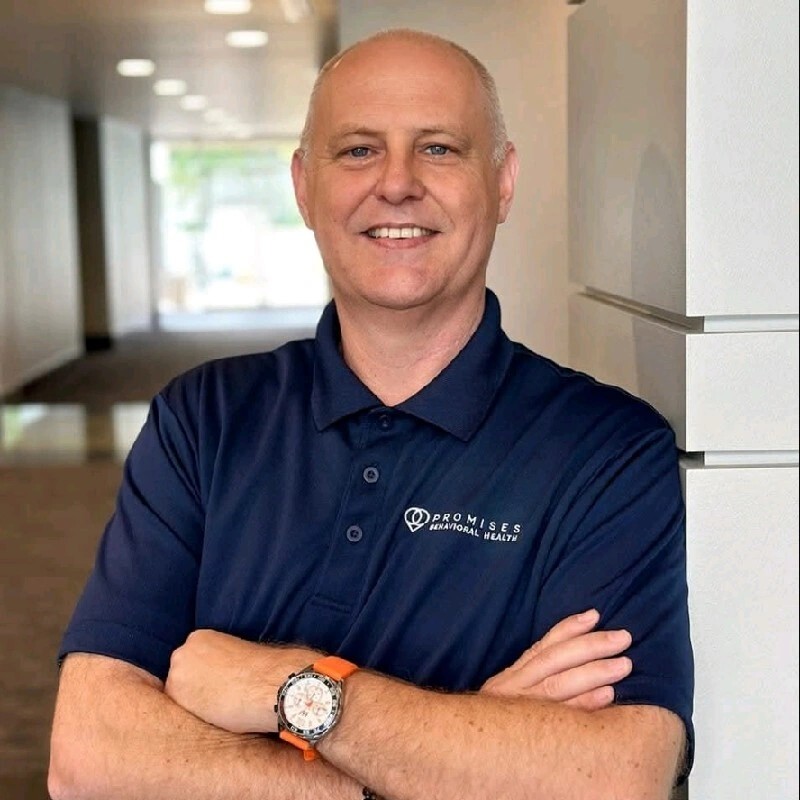
Executive Director - Promises Brazos Valley
David Ludlow is the executive director of Promises Brazos Valley, where he leads outcomes‑driven, skills‑based addiction treatment with a patient‑first approach. After decades of alcoholism and cocaine use culminating in six felony arrests and three prison terms, he entered treatment in 2017 at age 45 and rebuilt his life through structure, honesty, and community.